
Mixtape
Genre: Interactive Story-Driven Adventure
Players: 1
.
Review:
Occasionally you’ll see a videogame referred to as “cinematic” in reviews or by commentators. Some will even go as far as to say “it’s like playing a movie!”. But what this actually means has changed somewhat over the years.
Ms. Pac-Man was “cinematic” because stages were interspersed with brief little snippets of in-game cutscenes. Ninja Gaiden 2 was “cinematic” because the cutscenes between stages told a dramatic narrative story. Final Fantasy VI was “cinematic” because it had a story prologue and opening credits set to a stirring musical score. Early CD-based games like the original Resident Evil were “cinematic” because they made use of live-action footage to tell the game’s story. Metal Gear Solid was “cinematic” because the game’s action was in service to its story, told through dramatic voice acting telling a complex narrative that directly impacted the plot. Uncharted was “cinematic” because sections of the game were designed like action film set pieces. The Last of Us was “cinematic”, because its realistic characters gave moving performances in a gripping story on par with any actual zombie film, and arguably surpassing the film medium in its incredible storytelling.
I’m not going to take away from any of those games, any of those accomplishments. Because all of those were massive steps forward in videogame storytelling, and what it means to tell a story in the videogame medium. But I mention them here because while we might say “it’s like I’m playing a movie!”, you’re not, are you? Not really. You’re playing a game with movie-like elements. Or in some of the worst-case scenarios, you’re watching a movie that has had game elements shoehorned into it, usually in a way that doesn’t make for a fun game, and doesn’t enhance the movie.
Of course, the language of film isn’t the only language videogames have to tell a story – games ranging from Bioshock to Journey to The Stanley Parable all found different ways to work the interactivity into the narrative itself, and games like The Return of the Obra Dinn made piecing together the narrative the basis for its gameplay. But as visual storytelling goes, movies are often the point of comparison many look to, and as such a lot of videogame stories are designed with that in mind, trying to perfect the imitation of that language, and the integration into the gameplay. So you get stuff like the Silent Hill games using the “Dutch Angle” camera perspective to signal to the player that something very wrong is happening.
Mixtape, released in 2026 on PC, PlayStation 5, Xbox Series X|S, and Nintendo Switch 2, is a game that I feel is unique in this regard because this is a very “cinematic” game where the game’s creators have indeed copied elements of popular film techniques, but they’ve also added to it. This is to the point where I believe that while Mixtape is still very much a videogame (though one I would argue that players experience rather than play), if it or something like it was released in theaters, other filmmakers would look to it for inspiration.
The story premise of Mixtape is extremely low-stakes. Players follow teenage delinquents Stacy, Van, and Cassandra in their final day together as their high school years end and they come to terms with the fact that the next day they will drift apart. There’s no big romance here, no one’s lives are threatened, no one’s losing their business. It’s just three teenagers living their lives and coming to terms with how those lives are about to diverge from each other.
Despite the low stakes, the excellent characters keep things interesting. Our point of view character is Stacy, who is obsessed with music and feels compelled to always have headphones on, needing to set her life to a soundtrack, with this final day together represented by what she sees as her ultimate “mixtape”. Cassandra is highly talented, but made it a point to befriend Stacy and Van as an act of rebellion against a life her parents planned for her rather than one she wants for herself, and she’s also the one most outwardly affected by the impending breakup of their group. Of the main trio, Van is the least consequential to the plot, easygoing and mellow, mostly following the lead of the two girls and trying to calm things down when frictions arise.
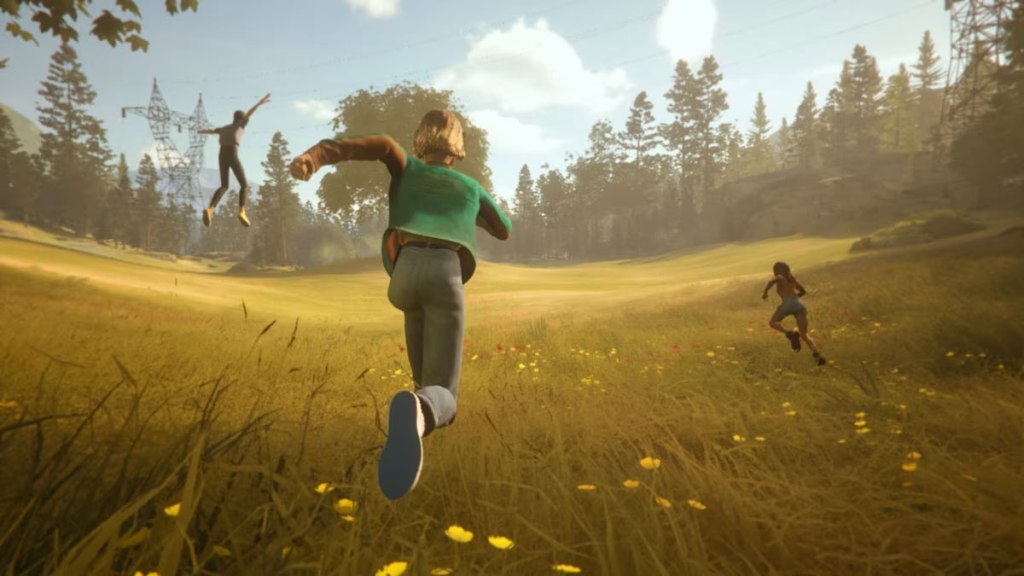
The story being told here fits neatly within the “coming-of-age tale” plot with a lot of parallels to films in that genre over the years, and the game dips into and out of surreal moments that make it clear that the things happening in the game aren’t always meant to be taken literally, such as scenes throughout the story where characters float or even fly, and the entire game is punctuated by Stacy breaking the fourth wall to announce and briefly describe the song in the game’s licensed soundtrack backing the next scene as if she were a radio deejay.
The soundtrack contains a variety of songs straddling genres, with a lot of rock, punk, and electro-pop, and these are interspersed by scenes with more subdued synthesized themes that reminded me a lot of the Stranger Things soundtrack. Of course, I need to mention the excellent voice acting here, which captures a lot of subtleties in the characters, as well as how… well, teenagers can be jerks, and kinda’ stupid sometimes too.
Despite the focus on the music, what really stunned me about the presentation of Mixtape was the visual design. The characters in this game are like the animated Spider-Verse films and KPop Demon Hunters in that they’re “animated on twos” to give a look that’s a bit like stop-motion. This is clearly a stylistic choice and not a hardware or skill limitation, as there is a lot going on here beyond the rough-looking character animation, with some excellent lighting, brilliant visual design, and outstanding dynamic camerawork. This game is a visual treat for the eyes, and while it’s not necessarily pushing any technical boundaries, and there are even still occasional issue with detail pop-in and aliasing, it is nevertheless stylistically jaw-dropping from start to finish.
Oh, and I should probably talk about the gameplay too, huh? Well, it’s there, but it’s kinda’ incidental. Like, giving players some interaction with the events of the game, like guiding Stacy around as she skateboards down a steep street, aiming when she’s skipping stones on a lake, or choosing her path as she soars through the air. Most often, what you’ll be doing is somewhat like a Graphic Adventure, where you’ll be moving around within an enclosed area, finding objects to interact with and pressing a button for her to pick it up or comment on it.
However, these gameplay elements don’t have any consequences (have Stacy skate into a speeding car and the game just rewinds and lets you try it again), and often you’ll find yourself just looking for the thing you’re meant to be interacting with so you can get on to the next part of the story.
This is probably one of Mixtape’s weakest elements – the gameplay just doesn’t feel very important to the game, it’s more of a window-dressing on top of the story. What’s more, because the story is so low-stakes, I could see this game not appealing to everyone, and it’s not like things are building to any big poignant reveal or dénouement.
However, that’s not to say that there isn’t a strong and engaging story here with interesting characters that ultimately reaches a satisfying ending. Mixtape is stunning in its stylistic ambitions, and I suspect years from now game designers and filmmakers alike will both look back on it as a milestone in the way we tell visual stories, with that story being a wonderfully entertaining one. And while it falls short on the actual gameplay, I think this is nevertheless a must-play game for anyone looking to see the videogame medium expertly used to tell a story.
tl;dr – Mixtape is an Interactive Story-Driven Adventure that has players following a trio of teenage delinquents on their last day together before their paths grow apart. This is a low-stakes story that nevertheless features some excellent characters and absolutely brilliant, inspired, wildly creative visual storytelling. It’s a shame that the gameplay itself is mostly incidental, but if you enjoy seeing the videogame medium used in creative ways to tell an engaging story, consider Mixtape a must-have.
Grade: A-
You can support eShopperReviews on Patreon! Please click HERE to become a Sponsor!
This month’s sponsors are Jamie and His Cats, Ben, Ilya Zverev, Andy Miller, Johannes, Jaka, Jared Wark, Gabriel Coronad-Medina, Francis Obst, Kristoffer Wulff, Seth Christenfeld, and Vince Verrinoldi. Thank you for helping to keep the reviews coming!


Leave a comment