
MIO: Memories in Orbit
Genre: Metroidvania
Players: 1
The Nintendo Switch 2 Difference
.
Review:
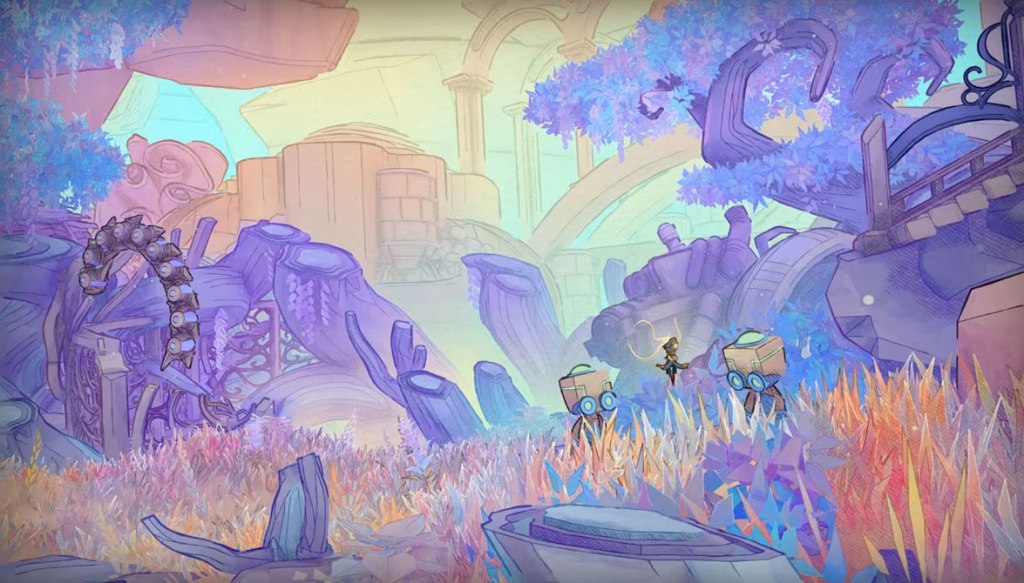
MIO: Memories in Orbit is a Metroidvania released in 2026 on PC, PlayStation 5, Xbox Series X|S, Nintendo Switch, and Nintendo Switch 2. This game puts you in the role of the titular MIO, a robot that awakens on a massive spacecraft that long ago became derelict, malfunctioning, crumbling apart, overgrown with dangerous plants and overrun with hostile machines.
The presentation in MIO uses sketchy-looking cel-shaded 3D visuals with painterly textures that fill in as you move, a visual style that seems an odd choice for this game’s mechanical denizens (who have some wonderful character designs, by the way), but nevertheless works wonderfully to make the presentation truly memorable, with some lovely pastel colors that run counter to the game’s somewhat somber tones, and some surprisingly large indoor spaces that really fill in the background and give a sense of scale, wonder, and the former glory of this now-crumbling ruin.
The soundtrack is also excellent here, blending choral music and quiet new agey synthesized themes and gentle acoustic instrumentals that give a weight to the game’s locales and struggles, along with some more intense techno-style themes for boss fights. Some examples here are Asma’s Ballad, The Frozen Path, Haven, Crow, Metropolis, and Poltergates.
There’s also surprisingly a really immersive story here, though I’d prefer to give away as little as possible, since you’re tossed into it without context and piece together what’s going on from characters you encounter and some magnificent worldbuilding. I’ll just say that the place Mio finds themselves in was once a place of hope, but has since fallen to despair, as the remaining peaceful robots each find their own ways to live out what seem likely to be their final days.
For the gameplay, I feel like MIO integrates some of the better elements of Hollow Knight and the Ori series. From the former, you get the modular upgrade system, the risk-reward that comes with potentially losing currency when you die, the map that doesn’t fill in as you explore but requires taking additional steps, and an overall high challenge level with some tough combat, though I think MIO is more fair and forgiving with its combat than Hollow Knight is.
From the Ori games, you get some excellent Platforming, with one of the game’s key mechanics being a double-jump that resets when you hit an enemy, potentially letting you stay in mid-air indefinitely as long as you still have enemies to fight. This joins a grapple-like “hairpin” upgrade you gain early on to give both platforming and combat an extra dimension in a way that felt reminiscent of Ori’s bash ability.
I should note that late in the game, the challenge level of the platforming becomes outright enormous, requiring players to quickly and skillfully chain together the multiple abilities you gain over the course of the game. However, I personally always found it so compelling that I couldn’t help but dive back in after dying to give it one more try. I should also note that some of the most difficult platforming sections have some camera issues, with the 3D visuals and 2D gameplay sometimes making it difficult to judge what’s safe and what’s considered a part of the automatic-death red plant tendrils that are found throughout the game. Still, despite this issue, the Platforming overall remains outstanding.
One other thing I think MIO does exceptionally well is its Metroidvania exploration, with the game constantly seeming to provide players numerous potential paths to explore, and even when you hit a bottleneck that’s usually just before things open up into numerous new options. The one complaint I’d have here is that your path is often blocked by doors requiring keys, or one-way doors requiring you to unlock them from the other side, and it would have been nice if these roadblocks were worked more organically into the gameplay.
All of these elements combine to make MIO: Memories in Orbit an absolute joy to play, and I feel like it absolutely deserves a place among the very best games in the genre. Its beautiful presentation, its environments that invite exploration, its challenging combat, and its great platforming all combine to make this a must-play game for any fans of the genre.
tl;dr – MIO: Memories in Orbit is a Metroidvania where players take the role of a robot trying to restore a massive failing spacecraft. This is a phenomenal entry in the genre combining elements of some of the best Metroidvania games to come before it, with a beautiful presentation, a great sense of exploration, challenging combat, and exceptional Platforming. Do not miss it.
Grade: A
.
The Nintendo Switch 2 Difference
MIO: Memories in Orbit (Nintendo Switch 2)
Genre: Metroidvania
Players: 1
.
Review:
MIO was released simultaneously on Nintendo Switch and Nintendo Switch 2, but features no upgrade path – whichever version you get is the version you’ll be stuck with. With this being the case, it raises the all-important question, how much improved is the Nintendo Switch 2 version?
Simply put, there’s definitely a noticeable difference between the two versions of the game. The Nintendo Switch 2 release of the game features much smoother framerates and improved resolutions compared to the Nintendo Switch version of the game. The framerates are the major improvement here – it makes this game’s challenging combat flow a lot more smoothly, and makes it easier to react with the precise timing battles sometimes require. Both Nintendo Switch and Nintendo Switch 2 do have occasional framerate hitches at specific points, but Nintendo Switch 2 definitely fares better here. This isn’t to say the Nintendo Switch version of the game is necessarily bad, just that the Nintendo Switch 2 version is absolutely an improvement in this regard.
Another improvement here is the loading times, with the Nintendo Switch version of the game taking 24 seconds to load to the title screen and an additional 22 seconds to load into the gameplay, with the Nintendo Switch 2 times being 17 seconds and 11 seconds.
Overall, the Nintendo Switch 2 version of the game is definitely improved, and I would argue that the improvements to the framerates alone should make this version the one to get if you’re pondering whether or not to just stick with the original Nintendo Switch release via backwards-compatibility. I think both versions of the game are great, but the Switch 2 version is absolutely the way to go if you have the choice.
tl;dr – MIO: Memories in Orbit is a Metroidvania where players take the role of a robot trying to restore a massive failing spacecraft. This is a phenomenal entry in the genre combining elements of some of the best Metroidvania games to come before it, with a beautiful presentation, a great sense of exploration, challenging combat, and exceptional Platforming. Do not miss it.
Grade: A
.
You can support eShopperReviews on Patreon! Please click HERE to become a Sponsor!
This month’s sponsors are Jamie and His Cats, Ben, Ilya Zverev, Andy Miller, Johannes, Jaka, Jared Wark, Gabriel Coronad-Medina, Francis Obst, Kristoffer Wulff, Seth Christenfeld, and Vince Verrinoldi. Thank you for helping to keep the reviews coming!


Leave a comment