
Mina the Hollower
Genre: Top-Down Action-RPG
Players: 1
The Nintendo Switch 2 Difference
.
Review:
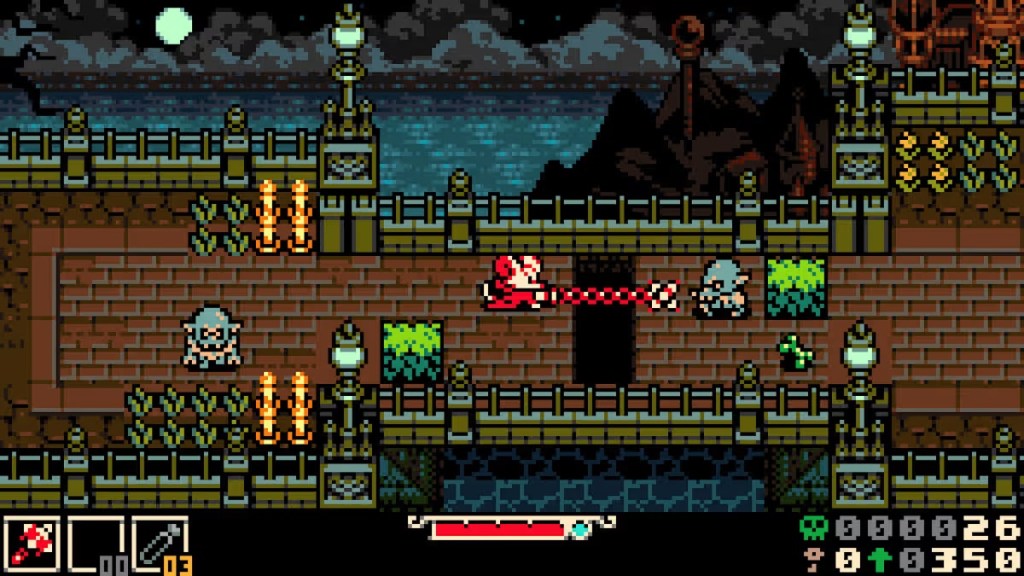
Mina the Hollower is a Top-Down Action-RPG released in 2026 on PC, PlayStation 5, Xbox Series X|S, Nintendo Switch, and Nintendo Switch 2. This game combines elements of classic Top-Down “2D”-style Zelda games, “Soulslike” games, and a bit of Castlevania for something wholly original. All of this is in service of a game filled with anthropomorphic animals (and other even more bizarre characters), including the titular Mina, a mouse summoned to Tenebrous Isle, where her monster-repelling inventions, spark generators, have suffered an attack from anarchic rebel forces leading to monsters laying siege to the island and its residents. Being a “Hollower”, a sort of daring adventurer, Mina feels doubly responsible to right the wrongs on the island, fighting the rebels and restoring the spark generators.
The Zelda influence is immediately apparent in the presentation, which uses 2D pixel art visuals styled to look like Game Boy Color graphics, directly evoking The Legend of Zelda: Link’s Awakening DX and the two Legend of Zelda Oracle games, but at the same time the monster designs often seem reminiscent of the Castlevania franchise, and the wide cast of kooky characters you encounter feels very reminiscent of developer Yacht Club Games’ own breakout hit Shovel Knight. It all combines to make Mina’s world alive, bustling, and very busy… something that’s a bit of a dual-edged sword, but I’ll get to that later.
All of this is backed by synthesized sound effects that, much like Shovel Knight’s, seem designed to tap into our fond memories of games from the original Nintendo Entertainment System and Game Boy, and a chiptune soundtrack that is similarly evocative of that era of gaming, with some noteworthy tunes including Blighted Docks, and Ossyx, and others I can’t find to link to at this time. In short, this game does a great job of capturing nostalgia with its sound design and music.
When it comes to the gameplay, my initial impressions were not great. While the look and premise of this game evokes a lot of fond memories of the classic Game Boy Zelda games, this is structurally quite different from Zelda, and surprisingly difficult for a retro-styled top-down Action-RPG. The game’s areas are filled with hazards to avoid, and enemies can be fast and difficult to predict.
In addition, this game makes use of multiple game mechanics that enhance the difficulty – you have a few healing flasks you can use when your health depletes, but these must first be charged by attacking enemies, a slow process that can require taking down multiple enemies before you get anything practical you can use. And you have a limited number of flasks too – even if you defeat a lot of enemies, if you’ve used all of them, you’re out of luck until your next save point, which are few and far between. And what’s more, this game makes use of the classic “Soulslike” mechanic where dying leaves all of your currency (bones in this game) in the area, needing for you to return to collect it or lose it permanently if you can’t make it back before dying.
In addition, Mina’s central gameplay mechanic, her burrowing ability, which sort of acts like a dash and a dodge roll combined in one, doesn’t always act the way you may think. Sometimes it can be used to dodge enemies and attacks, but other times hazards that are present on the surface will still damage her while she’s underground. Plus, this move requires players to jump first, making it slower to use, and ends in a larger jump needed to cross over pits and hazards, requiring more coordination and timing than if you were to just dodge or jump as its own move.
Here’s the thing though… all of these aforementioned complaints are in regards to game mechanics that are completely optional. The game contains within its option menus a developer-created “mod” system where you can change various parameters of the game. Change the amount of damage you give and take, change how quickly you amass bones, change the height of your jump, or numerous other parts of the game, with the only apparent penalty being that playing the game in any way that makes it easier causing your current game save to get locked out of earning in-game achievements.
Now, this menu is nestled in the games menus in a spot that might not be clear to players who don’t go searching for it, and the vast array of options can make it difficult to custom jerry-rig your own preferred difficulty level, but many of this game’s flaws, or at least game elements that some players may dislike, are eliminated through its use.
That’s not to say there aren’t still issues here, even issues this game doesn’t address with these “mods”. Some game mechanics aren’t really made clear to the player, such as an early requirement to know that you can jump out of burrowing even when you’re directly over a pit, allowing you to burrow under a low-hanging obstacle directly next to a pit. Some areas of the game seem to be accessible via one of the multiple “trinket” upgrades or “sidearm” secondary weapons but don’t seem to account for players who run out of energy for their side-arm or otherwise lose it in an area that might have been meant to be accessed via another means. And there are so many of these tricky areas that it seems like the game could have benefitted from more game testing to ensure that players reaching these areas didn’t do so via some unexpected combination of elements that resulted in them getting stuck.
There’s also an issue with this game’s nonlinear map design – it’s restrictive and convoluted in a mazelike way where it’s easy to get lost and have no sense of where you are relative to other areas or how to get back to a specific place. The entire map is filled with one-way passages you can permanently unlock from the other side by dropping a rope or destroying a barrier that’s only vulnerable from one side, but it’s not always clear if you’re meant to be able to get to that other side soon or if that’s for later in the game, and since you could be surrounded by these one-way passages, you could waste your time trying to figure out how to get past one while another one you dismissed as impassable earlier actually has a back entrance you could have accessed. Oh, and there’s no traditional map function here either, which is really frustrating.
In addition, this game’s map is absolutely filled to the brim with secrets in every corner, but sometimes it’s not clear what’s a secret and what’s just set dressing. Maybe that crumbling section of wall is just for appearances, or maybe you can attack it or do something else to open up a secret path. This game’s detailed visuals look nice, but they also look busy, so a part of the area that’s meant to stand out doesn’t do that because everything stands out.
There is just so very much stuff in this game, it can be dizzying, and can lead to analysis paralysis. How am I supposed to know where I’m supposed to go when the world is so dense and filled with noise, and everywhere seems to be blocked off but there could be any number of untold secrets hidden within that noise? It’s… a lot.
That’s the bad news. And the good news is… well, it’s a lot. As much as this game frustrated me, I kept coming back to it. I found myself thinking about it after putting it down and getting a break. “I wonder if I could use this thing in that place”, “I bet there’s something more to that thing over there”, “wait, what was the deal with that thing I meant to check out later?”. Time and time again, after I felt like I put down the game for good due to frustration, I realized that I still wanted to go back in and check something out… and more often than not, I was rewarded for doing so.
Mina the Hollower is absolutely filled to the brim with secrets, and some really clever puzzle design, in ways I’m tempted to share but it’s so much better to figure it out on your own. And every time you do figure something like this out, it helps you to gain a better understanding of the game’s world and how it works. And the game never stops being creative with its puzzles, its characters, and the various tools you gradually get at your disposal… though again, you don’t get these tools in a Zelda-style fashion, you just get them at random points in the game, and it could be something as mundane as a new trinket or sidearm… but then you find yourself thinking of ways that thing might be useful beyond its initial appearances.
And the core gameplay is enjoyable too, with Mina’s burrow ability hiding all sorts of interesting potential for movement, combat, and traversal, some of which may not be immediately apparent. Enemies are cleverly designed in ways to evade or thwart your attacks, forcing you to be smart in how you approach them. And bosses are also really creative in their design.
Overall, I think there’s no question that Mina the Hollower is a work of genius, but it’s an overwhelming genius, and not always in a good way. This game throws so much at the player that it’s often difficult to process, and by default it does so in a difficult and not very accessible way that’s sure to turn off some players. If you play this, I highly highly highly recommend that you acquaint yourself with the mod menu early on, and if you find yourself getting frustrated by the game, don’t be afraid to use it. But even after that, there’s still a fair amount of frustration to be had here. However, if you can have the patience to bear through this game’s frustrations, I think you’ll find there’s so much good stuff here that this is absolutely worth picking up… just be prepared for something that’s far more complex, confusing, difficult, and unorthodox than some Zelda-clone.
tl;dr – Mina the Hollower is a Top-Down Action-RPG with an aesthetic that evokes the classic Game Boy Zelda games, and combines elements of Zelda, “Soulslike” games, and Castlevania, all while being something entirely different and unique in its own right. This is a crowded, messy game, seemingly designed to frustrate the player at times, and surprisingly difficult. Thankfully there’s a developer-created “mods” menu that can assist in finding your preferred difficulty level, but even after doing so, there’s still a lot of frustrating design here. However, there’s also a ton of wonderful secrets, clever puzzles, and a world stuffed to the brim with wonderful, bizarre, creative things. Despite the frustrations and flaws, this game is full of so many amazing surprises that I recommend players to bear with it because there’s a wealth of joy to be found buried within too.
Grade: A-
.
The Nintendo Switch 2 Difference
Mina the Hollower – Nintendo Switch 2 Edition
Genre: Top-Down Action-RPG
Players: 1
.
Review:
Mina the Hollower released simultaneously on Nintendo Switch and Nintendo Switch 2, with a free upgrade pack to transform the former into the latter. Let’s have a look and see what that upgrade gets you, shall we?
The eShop page for the Nintendo Switch 2 release of the game boasts “higher refresh rates, larger screen resolutions, and HDR support”, but I have to be honest, I’ having difficulty seeing any of that in the game’s 2D pixel art visuals. I suppose maybe the movement looks smoother, but I’m not really sure about that.
The Nintendo Switch 2 version also claims to support Mouse Mode features, but as far as I can tell, all this amounts to is that Mina’s head looks in the direction you move the mouse… not exactly an integral part of the experience.
Really, the biggest difference I see here is the one that isn’t advertised – loading times. The Nintendo Switch 2 release of the game brings the time it takes to load to the title screen down from 10 seconds on Nintendo Switch to 3 seconds on Nintendo Switch 2. Loading into the game is pretty much instantaneous on both, so that’s about it for loading time improvements.
So… yeah, this isn’t really all that much improved on Nintendo Switch 2. I suppose it is a free update, so it can’t hurt to get it if you have a Nintendo Switch 2 and a copy of the game, but definitely don’t expect much to change with this game on Nintendo’s newer hybrid console.
tl;dr – Mina the Hollower is a Top-Down Action-RPG with an aesthetic that evokes the classic Game Boy Zelda games, and combines elements of Zelda, “Soulslike” games, and Castlevania, all while being something entirely different and unique in its own right. This is a crowded, messy game, seemingly designed to frustrate the player at times, and surprisingly difficult. Thankfully there’s a developer-created “mods” menu that can assist in finding your preferred difficulty level, but even after doing so, there’s still a lot of frustrating design here. However, there’s also a ton of wonderful secrets, clever puzzles, and a world stuffed to the brim with wonderful, bizarre, creative things. Despite the frustrations and flaws, this game is full of so many amazing surprises that I recommend players to bear with it because there’s a wealth of joy to be found buried within too.
Grade: A-
.
You can support eShopperReviews on Patreon! Please click HERE to become a Sponsor!
This month’s sponsors are Jamie and His Cats, Ben, Ilya Zverev, Andy Miller, Johannes, Jaka, Jared Wark, Gabriel Coronad-Medina, Francis Obst, Kristoffer Wulff, Seth Christenfeld, and Vince Verrinoldi. Thank you for helping to keep the reviews coming!


Leave a Reply