
Towa and the Guardians of the Sacred Tree
Genre: Action / Roguelike
Players: 1-2 Co-Op (Local / Online)
.
Review:
Towa and the Guardians of the Sacred Tree, released in 2025 on PC, PlayStation 5, Xbox Series X|S and Nintendo Switch, is an Action Roguelike that plays much in the style of the Hades series, with players going out on repeated runs as eight chosen warriors aiming to defeat the mystic threat that is spreading its evil across the land.
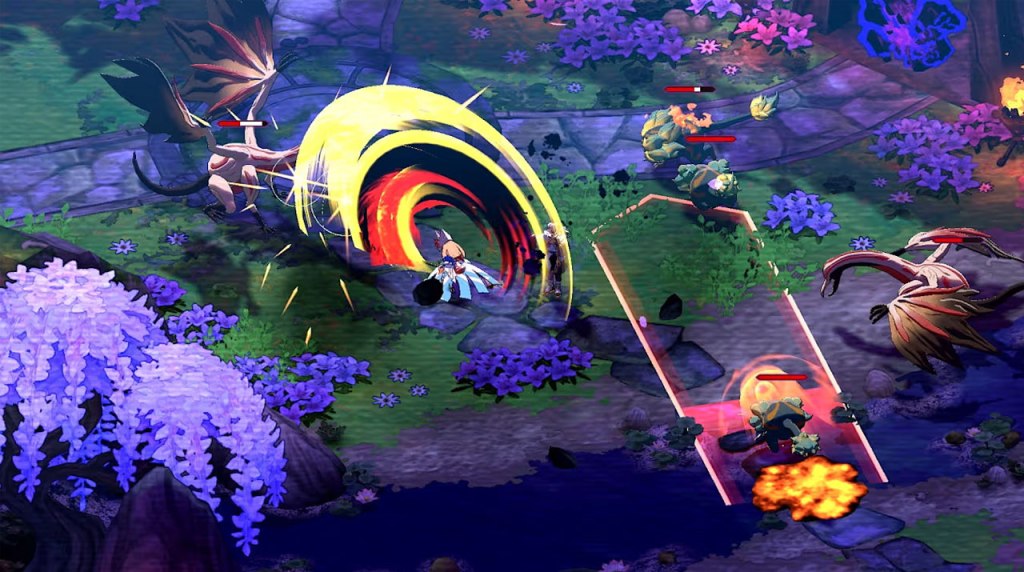
The core gameplay here will feel very familiar to those who played the Hades games, with players fighting enemies from a more or less isometric perspective, and clearing each room leads to a bonus that should make this run different from other runs. However, this game does some different things in its details that set it apart, and sadly not in a good way.
The big thing here is the game’s dual-character system. Players will be able to choose one of their characters to be a fighter swapping between two different swords, while the other is a magic-user, wielding two different types of magic attacks. The two characters share a split health meter, meaning that both remain active until the health of both characters are depleted.
Unfortunately, the game’s AI is absolutely terrible at avoiding enemy attacks, and even though the second character will trail after you and generally follow your movements, they’re slow to do so and can easily just start stupidly taking hits rather than following your movements to get out of the way.
You do have a few ways to avoid this. You can use the right analog stick to take direct control of this second character… but doing so then forces you to multitask in a way that’s unintuitive, and it’s frustrating to have to move both characters just because the game’s AI is too dumb to move the second character out of the way.
The other alternative is to get a friend to join you… but doing this just means that each player is only playing half a character, since the abilities are split between characters, leaving individual characters lacking in what they can do. In particular, the second character only has a dash and two magic attacks, which can only be used sporadically.
Meanwhile, the main character has a dash, an attack with one sword, a sword-swapping attack to use the second sword, an attack with the second sword, and a special attack that requires a long build up before using. The sword-swapping thing may seem like an interesting idea, but the game forces players to engage with it by “breaking” a sword if you keep using it for too long, and since one of the two swords always uses slow charging attacks, you’ll find yourself frustrated with it in battles with faster foes. You can always swap and swap back to recharge a sword, of course, but even just having to do this is a frustrating requirement.
This game also fails to be compelling as a Roguelike, as the upgrades you get in each run are largely stat-based, meaning that you’ll easily find yourself engaging in multiple runs that feel identical, just with different stats. There are also permanent “Roguelite” upgrades, but these too are often just stat-based. These upgrades are often tied to minigames that, while interesting, feel disconnected from the overall game.
The game’s mythical, vaguely Asian-inspired story also fails to feel especially fresh. A town’s protective spirit personified in a small girl, Towa, has gathered together 8 warriors to fend off the evil bad spirit infecting the land. While these characters are all colorful and unique, we’re not really given any introduction to them, and must glean what we can of them off of their interactions.
At the very least the other elements of the presentation are quite good here. The voice acting for the characters is solid, as is the excellent orchestral and synthesized soundtrack with Asian influences created by Final Fantasy Tactics composer Hitoshi Sakimoto. For some good examples, check out Prayer Children, Grass and Ruts, Grass and Ruts – Calamity, Reverberation – Calamity, Empty Boat – Calamity, Conflicting Prayer – Towa, Shinju Village, Shinju Village -Henryo-, and Chant.
The visual presentation is also quite striking, with brilliant use of color, striking character designs, and an overall visually-beautiful world constructed using a mix of 2D and 3D visuals. My only gripe here is that the relatively low framerate on Nintendo Switch causes scrolling to be a bit rough in a distracting way at times.
The result of all of Towa and the Guardians of the Sacred Tree is a game that has an absolutely wonderful presentation, and I applaud it for trying to use some interesting mechanics in a formula that has otherwise worked well, but those game mechanics generally fall flat, and the Roguelike elements of the game aren’t done well either. I still think some players may find that they can enjoy this game despite its flaws, but it’s tough to recommend when the far superior Hades II also released this year at the same price. And there are plenty of other excellent games in this genre as well too. Get one of those instead.
tl;dr – Towa and the Guardians of the Sacred Tree combines Action and Roguelike elements in a way that’s similar to the Hades games, and it has a gorgeous presentation, but there are multiple game mechanics that simply do not work here, and the bland Roguelike elements don’t help either. While this isn’t a terrible game, you have multiple other better alternatives on Nintendo Switch.
Grade: C+
.
You can support eShopperReviews on Patreon! Please click HERE to become a Sponsor!
This month’s sponsors are Jamie and His Cats, Ben, Ilya Zverev, Andy Miller, Johannes, Jaka, Jared Wark, Gabriel Coronad-Medina, Francis Obst, Kristoffer Wulff, Seth Christenfeld, and Vince Verrinoldi. Thank you for helping to keep the reviews coming!


Leave a Reply