
Today, I’m adding more games to the list of games that have seen improvements when played on Nintendo Switch 2. Let’s have a look!
- Sea of Stars (Nintendo Switch 2)
- Stray (Nintendo Switch 2)
- Super Mario Bros. Wonder – Nintendo Switch 2 Edition + Meetup in Bellabel Park
.

Sea of Stars (Nintendo Switch 2)
Genre: Turn-Based JRPG
Players: 1-3 Co-Op (Local)
.
Review:
Alongside the game’s final free update, Sea of Stars has received a Nintendo Switch 2 version, which includes the game’s free Throes of the Watchmaker DLC to save everyone an additional download. For players who own a digital copy of the Nintendo Switch version of the game, the Nintendo Switch 2 release is free to download. Let’s have a look and see what this release offers!
First, I should note that even though this isn’t a Nintendo Switch 2 Edition game, there is a way to transfer over your Nintendo Switch save file. But to do so, you need to download the Nintendo Switch version onto your Nintendo Switch 2 and download the save file from the cloud. Yeah, this is a little awkward and inconvenient, but I suppose it’s nice that the feature exists at all.
And when it comes to improvements… as far as I can tell, it’s not much. If there’s any boost to resolution or framerates, I’m not seeing it. No additional content or features as far as I can tell either. The only change I can detect here is to loading times: on Nintendo Switch, it took me 42 seconds to load the game to the title screen and 18 seconds to load a save file. On Nintendo Switch 2, those times are cut down to 26 seconds and 11 seconds.
The improved loading times are nice, but I feel like they don’t really justify this release. Make no mistake, I’m glad we have it – Sea of Stars is a superb RPG, and getting any improvements at all is welcome. Just don’t expect much different in this release.
tl;dr – Sea of Stars is a Turn-Based JRPG inspired by classics of the genre like Chrono Trigger, featuring a beautiful soundtrack, gorgeous pixel art graphics, and endearing and wonderful characters. It’s not without its problems – the overall plot is nothing special, the combat is clever but also frequently tedious, and the progression is slow as molasses. However, while it’s not quite on par with the greats of the genre it’s designed to imitate, Sea of Stars is nevertheless an excellent JRPG that fans of the genre should consider a must-play game.
Grade: A-
.

Stray (Nintendo Switch 2)
Genre: Misc.
Players: 1
.
Review:
Since Stray was first created with the PlayStation 4 and PC in mind, and was graphically quite a nice-looking game, it was one of those games that seemed like it would have to make severe sacrifices to work on Nintendo Switch. However, Nintendo’s aging hybrid console surprisingly delivered a competent port of the game with shrewd compromises to work on the less-powerful hardware.
Now that Nintendo Switch 2 is out, this is no longer an issue, so we’re going to look at how much things are improved when we look at the Nintendo Switch 2 release of the game, which is not a Nintendo Switch 2 Edition, but is free to download for anyone who has the digital copy of the Nintendo Switch version of the game. However, this does mean that your save file won’t transfer over – you may be able to upgrade for free, but you’ll be starting a new game file.
The main differences you’ll be looking at here are resolution and lighting. Compared to the Nintendo Switch version of the game, which ran at 1080p docked and 720p in handheld mode, the Nintendo Switch 2 version runs at 4K docked and 1080p in handheld mode, and the lighting effects are much nicer. You’ll also noticed more detailed fur on characters who have it, like your own character. You’ll also see fewer artifacts, aliasing, and dithering “noise”.
Surprisingly, other things you might expect to be improved here haven’t been. The framerate remains at 30FPS, and the textures and character models seem much the same in both versions as far as I can tell. Even the loading times aren’t much improved – on Nintendo Switch it took me 13 seconds to start the game and 20 seconds to load a save file, compared to 10 seconds and 19 seconds on Nintendo Switch.
There is one other “improvement” here, though I use that word loosely. You can now also control the camera using dynamic Mouse Mode. It’s a nice addition, to be sure, but one I feel like many players won’t bother with or even notice it’s there.
Overall, this is still a great-looking game and it is improved on Nintendo Switch 2, just not as much as you might expect. Still, as a free upgrade for Nintendo Switch players, this is a decent improvement, well worth getting, at least if you’re planning to start the game over again.
tl;dr – Stray is a game that has players taking the role of a cat exploring a post-apocalyptic cyberpunk-style city, and while it is difficult to pin to a genre, it shines through with its blend of superb level design and gameplay variety, its engrossing story and lore, and its impressive graphics that, while not a massive upgrade over the Nintendo Switch version, still look excellent on Nintendo Switch 2. And while I have some nitpicks with controls and occasionally unclear goals, overall I think this is a magnificent game that absolutely needs to be played.
Grade: A-
.
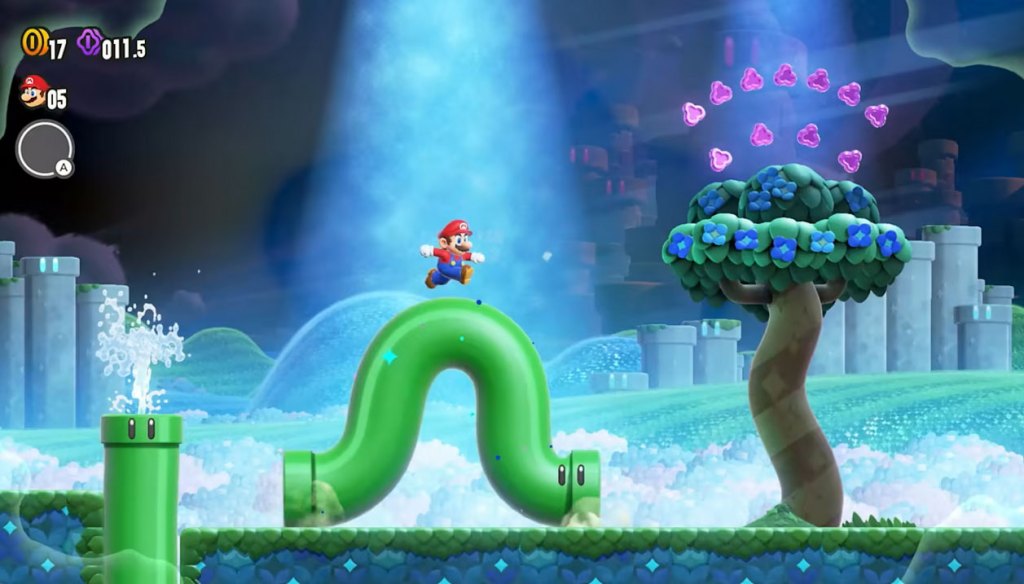
Super Mario Bros. Wonder – Nintendo Switch 2 Edition + Meetup in Bellabel Park
Genre: Platformer
Players: 1-4 Co-Op / Competitive (Local, Local Wireless, Online), 5-12 Competitive (Local Wireless, Online), Online Content Sharing, GameShare Support
.
Review:
Super Mario Bros. Wonder was always a natural choice for receiving a Nintendo Switch 2 Edition release. It’s the most recent wholly new game in Nintendo’s flagship Mario franchise, it was both critically and commercially well-regarded, and its “Wonder” mechanic gave it a natural hook for more content. However, I think that when this Nintendo Switch 2 Edition was announced, it led to a lot of mixed feelings.
To start with, the $20 upgrade pack for players who purchased the Nintendo Switch release of the game already puts this among the priciest of Nintendo Switch 2 upgrades, with an $80 price tag to buy the whole package. In addition, a lot of the added content seemed to be multiplayer-focused, which just isn’t going to appeal to a lot of players. So, this all leads to the question: what are you getting for your $20, and is it worth it?
Let’s look at the changes to graphics and performance first. The difference in graphics on Nintendo Switch 2 isn’t as dramatic as it is in some other games, but it is absolutely noticeable, with both the resolution and framerate getting a solid bump that really makes the game look better, even though the original Nintendo Switch game still looks pretty good overall.
However, the improvements to the loading times are even more impressive – on Nintendo Switch, it took me 24 seconds to load the game to the main menu, another 28 seconds to load a game save, and 8 seconds to load into a level. On Nintendo Switch 2, those times are goomba-stomped down to 7 seconds, 4 seconds, and 7 seconds. There are a lot of loading times sprinkled throughout this game, so reducing those means you’ll spend a lot less time here waiting, and a lot more playing.
There are plenty of other improvements, but even though the game has a separate Bellabel Park mode (I’ll get to that in a moment), I think it’s fair to say that many of the improvements are strewn throughout the game rather than lumped all in one place. Let’s run through them.
First, right from the start, players gain access to two new playable characters: Rosalina and Co-Star Luma. Rosalina is just a normal character with all the same abilities as Mario, Luigi, Peach, and most of the rest of the Super Mario Bros. Wonder cast. Luma, on the other hand, is a character that can only be selected in multiplayer, cannot take damage, and can be controlled using Mouse Mode controls – basically, this is an assist character for younger or less-experienced players to participate in the game alongside a more experienced player.
Second, the game now has sounds that come through your controller (Nintendo Switch 2 controllers have a speaker, I guess. Who knew). Mostly, this is just the little utterances by your prince sidekick, the sounds of music blocks as you step on them, and a few other things – nothing major, but worth noting all the same.
Third, players will gain access to the Bellabel Park area after completing the first four stages of the game – after this, you’ll see a path blocked off by a piranha plant on the left side of the screen that can be opened up using three wonder seeds. Until you have done so, the Bellabel Park area remains shut off, and cannot be selected from the main menu.
Upon entering the Bellabel Park area, you’ll gain access to multiple new features, only some of which are multiplayer-focused. For solo players, you’ll unlock a new side-story involving the Koopa Kids, where players gradually gain access to these optional levels throughout the game. Each of these levels is unique and creative, and involves an original boss battle – something many players complained were lacking in the main game.
These levels also include a new super flower pot power-up where players can briefly flutter jump/float and shoot a wide flower petal upwards to attack enemies above you. It’s a nice addition to the assorted power-ups, though not so exceptional you’ll feel overpowered.
Also in the Bellabel Park area are new challenge stages players can tackle, such as trying to collect all coins in a small area as fast as possible, or trying to eliminate all enemies in a small area as fast as possible. It’s nothing major, but it’s an entertaining challenge for solo players wanting for more content in this game on top of the Koopa Kids levels.
Completion of pretty much any of the extra tasks or levels in the new Bellabel Park content gives players a new in-game currency that can be spent on a few different things, including watering sprouts that give an assortment of awards. Those awards range from decorations that you can place in the Bellabel Park area to new “dual badges” that combine two badges from the base game.
Okay, now let’s talk about that multiplayer content. This is split into three parts: Local Multiplayer, Game Rooms, and GameShare. All of these game modes work for both the base game and the new Bellabel Park content, but some parts of Bellabel Park are specifically-designed with Game Rooms in mind, so let’s address that first.
The Game Room is a mode specifically for online or local wireless play, with each player needing to own a copy of the game. In other words, the Game Room sections of the game do not support GameShare or local multiplayer, and you can’t play with random players online either. So, if you only have one copy of the game, you won’t be able to access these areas, which include six competitive multiplayer games.
All of the other multiplayer content is accessible whichever way you choose to play, as long as you play with friends, including GameShare with a regular Nintendo Switch, even if that player doesn’t own a copy of Super Mario Bros. Wonder. This content includes 6 additional competitive multiplayer games, as well as 5 Co-Op games.
These games range from “get the most coins”, “defeat the most enemies” and “survive the longest”-style minigames to more creative stuff like a minigame that has players competing in a game of hide-and-seek, or a co-op game where one players creates platforms (using a cursor or Mouse Mode) that other players will need to use to complete the level. Overall, it’s a good amount of multiplayer content that should be entertaining for players who enjoy Platformers and want to play with or against friends.
This is undoubtedly one of the longest Nintendo Switch 2 Difference articles I’ve written at this point, because there’s a lot of added content here. But we get back to the big question – is it all worth the extra $20? And honestly that is a very difficult question to answer. Make no mistake, this version of Super Mario Bros. Wonder is greatly-improved over the Nintendo Switch version of the game, in numerous ways at that. But that’s also a part of what makes this so difficult to assess – because it doesn’t add something huge in any one area.
The improved graphics and especially improved loading times absolutely make the entire game better, but not $20 better. The new side-story single-player content and challenge levels are excellent additions, but you could knock them out within an hour or two, tops. The new multiplayer content is excellent… but only if you’re looking for multiplayer, and even then you won’t be able to enjoy all of it unless you have a friend who owns the game too.
In many ways, much of what’s here feels like it would have been great if it was in the game to start with, letting you discover it naturally as you progressed through the game normally. The Koopa Kids stuff in particular seems like it would have naturally fit into the game from the start, and if you’ve already completed the game it seems odd to go globetrotting to get to all the locations where you access these new levels. The new Luma sidekick character as well – a great inclusion for new players with a young kid or a non-gamer significant other… but not something you’re likely to return to the game for if you already played it when it originally came out a few years ago.
Okay, well what if we assess this as a complete experience, then? Just take it all in together, as if this was a players’ first time playing the game? Well, then yes, this is definitely the most ideal way to play Super Mario Bros. Wonder, a truly excellent version of a truly excellent game… but it’s not a game that I’d say is worth $80. And it’s strange, because I did think the original game was worth $60, and I do think this new content is worth the extra $20 if you’re approaching it organically rather than after the fact having already completed the base game. But… well, this is where Nintendo never reducing the prices of their games really starts to mess with perceived value, because I just can’t see this being worth $80, and for players who played the Nintendo Switch version years ago, I can’t see them wanting to dive into this content for $20, at least not all of it.
I feel like I’m going in circles here. Look, I’ll just let you make your own decision. Super Mario Bros. Wonder + Meetup in Bellabel Park is a wonderful expansion that adds a ton of new content, features, and graphics and performance upgrades to what was already a fantastic game. Despite this, it’s a hard sell because of how scattered this new content is. I suppose whether it’s worth it to you really depends on… you.
tl;dr – Super Mario Bros. Wonder is a family-friendly Platformer that brings Mario back to 2D with brand new “wonder effects” that transform every level in the game in creative, inventive ways that infuse this game with tons of variety and personality. The Nintendo Switch 2 Edition adds a ton of new content, features, and upgrades that enhance the game in numerous ways, though it’s hard to say whether that’s worth $20. Ultimately, I think this game doesn’t reach the same heights as Mario’s classic adventures, but it is nevertheless a truly excellent Platformer that any fan of the genre should absolutely play, and this is definitely the definitive way to play this game.
Grade: A-
.
I hope you enjoyed this latest batch of Nintendo Switch 2 Difference Mini-Reviews, and found them to be helpful! Want to see all Nintendo Switch 2 Difference comparisons? Check out this page for links to every article where I’ve included these comparisons!
.
You can support eShopperReviews on Patreon! Please click HERE to become a Sponsor!
This month’s sponsors are Jamie and His Cats, Ben, Ilya Zverev, Andy Miller, Johannes, Jaka, Jared Wark, Gabriel Coronad-Medina, Francis Obst, Kristoffer Wulff, Seth Christenfeld, and Vince Verrinoldi. Thank you for helping to keep the reviews coming!


Leave a Reply