
Hyrule Warriors: Age of Imprisonment
Genre: Action Brawler
Players: 1-2 Co-Op (Local, Local Wireless, Online); GameShare Support
.
Review:
Nintendo’s collaborative efforts with Dynasty Warriors series developer Omega Force never ceases to surprise. When we first learned about the original Hyrule Warriors, it surprised us to see Nintendo lend one of their most cherished properties out for a spin-off game combining the series’ classic characters, locales, and gameplay elements for use in a “Musou”-style game much like the Dynasty Warriors games, but it seemed like a cool one-off project. Then, when Fire Emblem Warriors was revealed, we were introduced to the possibility that this pairing of Nintendo property and Musou-style gameplay would be expanded to other properties as well. What would come next? Xenoblade Warriors? Kid Icarus Warriors? Super Mario Warriors?
Well, as we would come to find out, what happened next was a return not just to the Zelda franchise, but to a specific iteration of the Zelda franchise, with Hyrule Warriors: Age of Calamity giving us a game that wasn’t just some love-letter to a franchise, but instead specifically taking place within the world of The Legend of Zelda: Breath of the Wild, a formula that we’d see repeat again when Fire Emblem Warriors: Three Hopes took place within the world of Fire Emblem: Three Houses.
Then, in 2025, the pair surprised us all yet again, returning once more to the world introduced to us in The Legend of Zelda: Breath of the Wild, but this time taking place in that game’s direct sequel, The Legend of Zelda: Tears of the Kingdom, with the game’s events this time purportedly being canon to the overarching story of the series. But even more surprising than this was that the game was announced as a part of Nintendo’s big reveal for the Nintendo Switch 2 as one of the first Nintendo Switch 2-exclusive games.
As with Age of Calamity, Hyrule Warriors: Age of Imprisonment is still at its heart a family-friendly “Musou”-style Action-Brawler, but it doesn’t just wear the Zelda license as a flimsy costume. This really is a melding of the former’s gameplay and the latter’s story, characters, locations, enemies, and numerous gameplay mechanics.
Those who haven’t yet played and completed The Legend of Zelda: Tears of the Kingdom may want to do so before playing Age of Imprisonment, both because Tears of the Kingdom will provide a greater context to some of this game’s story and its gameplay elements, but also because this game contains spoilers for the story of Tears of the Kingdom, and so too will this review. On that note: STORY SPOILERS FOR THE LEGEND OF ZELDA: TEARS OF THE KINGDOM IN THE NEXT TWO PARAGRAPHS.
The Legend of Zelda: Age of Imprisonment takes place during the events we see in glimpses of the past during The Legend of Zelda: Tears of the Kingdom. In that game’s prologue, Princess Zelda discovers a “secret stone” that magically whisks her away to the distant past where she meets Rauru and Sonia, the first king and queen of Hyrule. Over the course of Tears of the Kingdom, we saw in flashbacks that Zelda befriended that era’s royal family, and also get caught up in their conflict with Ganondorf, a name Zelda immediately recognizes as alarmingly similar to Ganon, the threat she only just recently managed to put an apparent end to with series protagonist Link’s help after 100 years of a magical stalemate between the Zelda and the villain.
The Legend of Zelda: Age of Imprisonment takes place entirely within that 10,000 years-old era and expands on the flashbacks we saw in Tears of the Kingdom, showing us more in-depth how Zelda befriended the Hyrulean royals, worked with them on researching both the Zonai constructs and the magical powers of the secret stones, and helped them to contend with the growing threat of Ganondorf.
Because this game reprises the plot and characters from Tears of the Kingdom, it also brings back the voice actors to reprise their roles, which they do admirably here, especially Zelda voice actress Patricia Summersett. These returning characters are joined by a decent-sized cast of new characters, both giving us a decent variety of playable characters to choose from and expanding upon the world and story we only saw glimpses of previously. These new characters vary in how successful they are – I found the new Korok character Calamo to be adorably charming, but Zelda’s new chambermaid Lenalia seems really out of place with this game’s overall tone.
As for the rest of the presentation, The Legend of Zelda: Age of Imprisonment doesn’t use the added power of the Nintendo Switch 2 to do anything dramatically impressive beyond what we already saw in Age of Calamity. Rather, it uses the added horsepower mainly to address the performance issues that were increasingly plaguing the Nintendo Switch Warriors games. As a result, while Age of Calamity looked and sounded very much like The Legend of Zelda: Breath of the Wild but with a lot more slowdown, Age of Imprisonment looks visually very much like The Legend of Zelda: Tears of the Kingdom – Nintendo Switch 2 Edition, with that re-release’s improved resolution and textures, and more importantly with smooth framerates and without any slowdown to be found. In other words, this isn’t a great graphical leap so much as it is dramatically more playable, eliminating one of the biggest complaints many had of Age of Calamity.
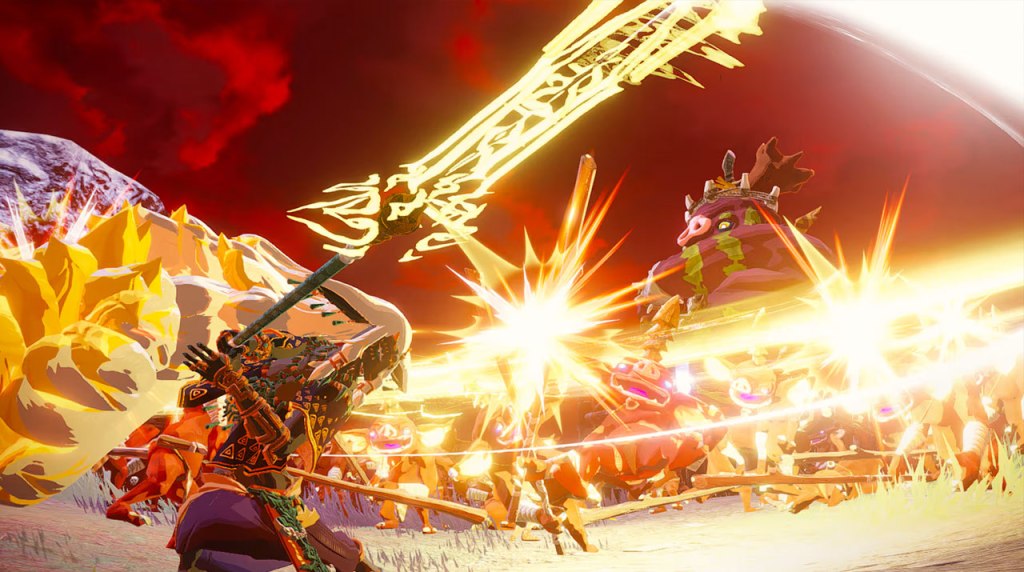
When it comes to the gameplay, we have some very clever use here of gameplay mechanics and game elements from Tears of the Kingdom. Returning from the prior game are the precise dodge/flurry rush attack move and character-specific skill attacks. Here, those skill attacks are frequently used to counter specific enemy attacks, such as using anti-air counters against jumping or flying enemy attacks. However, in addition to the skill attacks you now have Zonai devices you can set up to a custom button combination, letting you balance out your characters with attacks they may not have in their usual repertoire but that enemies may be weak to.
This game also introduces team-up attacks that build up when fighting alongside an ally, with each pairing doing something different, such as Zelda and Rauru letting players use the two analog sticks to aim dual lasers of light at enemies, or Zelda and Mineru teaming up to temporarily have Zelda riding in a massive construct and wreaking havoc on enemies.
Another welcome addition here is the inclusion of both the Depths and the Skies as potential locations to battle in, adding some nice variety to the game’s locales. Other gameplay elements from Tears of the Kingdom that play a role here include batteries to charge up Zonai devices rather than having to wait for them to recharge over time, device dispensers which act as a way to get new Zonai devices, and even small things, like how flux constructs fall apart if you use an attack that specifically targets their weak cube, or froglike frox enemies in The Depths that can be leapt on using a context-sensitive command to target the sensitive ore-like growths on its back.
I should note that one other thing that Hyrule Warriors: Age of Imprisonment does impeccably well is co-op multiplayer, with this game bringing back split-screen co-op, but now in addition players can also use GameShare to play on separate screens, a feature I’m immensely grateful to find included here. Either way, this is an outstanding way to thrash thousands of enemies with a friend.
When it comes to complaints, I have two. The first is pretty well-known for anyone who’s ever played a “Musou” game – combat can get pretty repetitive sometimes. The game tries to mitigate this with more satisfying battles against stronger opponents that require strategy and timing, but when you’re facing off against an army of mooks you’ll be doing a lot of button-mashing.
As for the second complaint, it’s one of missed opportunity. While Hyrule Warriors: Age of Imprisonment makes use of numerous game mechanics from Tears of the Kingdom, it still doesn’t touch some of that game’s more noteworthy features: This is not an Open-World game and doesn’t really have Zelda-style puzzles, even the physics-based ones Breath of the Wild and Tears of the Kingdom were known for. But more specifically for Tears of the Kingdom, we don’t really see anything here like that game’s Ultrahand or Fuse abilities. How cool would it have been to custom-build your own vehicles to take into battle here, or to fuse two weapons to create your own custom weapon? Alas, the closest we get to this are small nods in the move sets of characters like Mineru, whose attacks largely consist of summoning Autobuild-style simple vehicles to ram into enemies to fight for her.
Still, despite the sometimes repetitive combat and the missed opportunity to truly do something great with Tears of the Kingdom’s signature game mechanics in a different genre, Hyrule Warriors: Age of Imprisonment is still a joy to play. While combat can occasionally get repetitive, it’s frequently fantastic. The expansion of Tears of the Kingdom’s story is wonderfully-told here. And the phenomenal multiplayer gameplay makes this a must-have for players looking for a great co-op game on Nintendo Switch 2. Unless you’re the sort of player who despises Musou games, despises the Zelda franchise, or hasn’t played through Tears of the Kingdom yet and wants to avoid spoilers, this is a game I think you should consider a must-have on Nintendo Switch 2.
tl;dr – Hyrule Warriors: Age of imprisonment is a “Musou”-style Action Brawler that expands on Zelda’s story from The Legend of Zelda: Tears of the Kingdom. This game is an outstanding blend of Musou gameplay and Tears of the Kingdom’s characters, world, story, and game mechanics, and the Nintendo Switch 2’s improved hardware ensures that this time there aren’t any performance issues. While the combat can occasionally be repetitive and it feels like this could have gone even farther with its use of Tears of the Kingdom’s game mechanics, this is overall a fantastic game with great action, an excellent story, and outstanding co-op play. Do not miss it.
Grade: A
You can support eShopperReviews on Patreon! Please click HERE to become a Sponsor!
This month’s sponsors are Jamie and His Cats, Ben, Ilya Zverev, Andy Miller, Johannes, Jaka, Jared Wark, Gabriel Coronad-Medina, Francis Obst, Kristoffer Wulff, Seth Christenfeld, and Vince Verrinoldi. Thank you for helping to keep the reviews coming!


Leave a comment