
Final Fantasy VII Rebirth
Genre: Action-RPG / JRPG
Players: 1
.
Review:
I remember when I first heard that the then-upcoming Final Fantasy VII remake would be split into three games, and at the time it seemed like a cynical decision to milk as much money out of the project as possible, like splitting the final Harry Potter and Twilight books into multiple movies. After all, Final Fantasy VII is one of the most popular videogames of all-time, with a rabid fanbase, and if they’re given something chopped up into three full-priced products, surely they’ll gobble them up all the same even though they’re being manipulated into paying three times the price.
I don’t think that anymore.
I think it became clear to everyone after playing the first game in this trilogy, simply titled Final Fantasy VII Remake, that this wasn’t a lazy cash-grab in even the slightest way. Quite the contrary, this trilogy was clearly one of the most ambitious remakes in videogame history, and it feels like almost a miracle that these games even exist. In seemingly every area where this trilogy’s creators could take risks, they seemingly took the riskier path. In graphics, in presentation, in gameplay, in story, in overall scope, to the point where Final Fantasy VII Remake challenged the very concept of what a “remake” actually is, what the word means.
As I wrote in my review of the Nintendo Switch 2 version of Final Fantasy VII Remake Intergrade, the result wasn’t a perfect game. I think the new real-time action-based combat system is divisive in a way that some will love it and others will hate it, and Remake’s extremely linear progression is sure to frustrate RPG players used to more freedom and exploration. However, even with these issues, it was such an impressive undertaking that it was difficult not to stand in awe of its accomplishments despite its flaws.
When the second game in the trilogy, Final Fantasy VII Rebirth, released in 2024 on PlayStation 5, with a port to PC in 2025, and then in 2026 to Xbox Series X|S and Nintendo Switch 2, it addressed one of these issues, at least. After an initial recap of the ending of the prior game and a flashback to protagonist Cloud’s recollection of the Nibelheim tragedy tying him to Tifa and antagonist Sephiroth, Final Fantasy VII Rebirth begins with the events in the original game after the heroes depart the city of Midgar and see the greater world around them.
In the original game, this was your first time venturing out onto the world map, roughly 5-8 hours into the game, finally getting you out of the game’s depressing opening locale and opening up the game dramatically. Here, it has much the same effect, but rather than being on a world map, you’re able to finally venture into an open-ish world. I say “-ish” because Final Fantasy VII Rebirth isn’t quite an Open-World game, you can’t just go anywhere you want, and there are destinations you need to travel to in a designated order to progress the game’s story. But even so, you’re given a sizable world to explore with plenty to see and do within that world.
That brings me to one of the more interesting additions you’ll find in Final Fantasy VII Rebirth compared to Remake – this game doesn’t shy away from Final Fantasy VII’s sillier elements like the Golden Saucer and its minigames. In fact, if anything, it expands on them with a surprising variety of activities to participate in. Key among them is a new in-game turn-based Collectable Card Game, Queen’s Gambit, which may well be the best such in-game Card Game we have ever seen in a Square Enix RPG.
There have been additions, changes, and refinements made to other elements of the gameplay here as well. This game really builds on the relationships between characters, with each character pairing able to build their relationships with each other based on responses in text conversations and by joining together in battle, with new synergy abilities that let characters team up for attacks and abilities unique to that pairing. There’s also the new “Folio” upgrade system that seems vaguely reminiscent of Final Fantasy X’s sphere grid system.
All of this is in addition to what was present previously in Final Fantasy VII Remake, which is to say that it is a magnificent, bold reimagining of the gameplay, story, characters, and world of Final Fantasy VII that expands greatly on what was in the original game. In terms of combat, as I’ve said, that means a completely different real-time action-focused combat that I’m still not the biggest fan of but I can also see that being a matter of personal preference.
And as for the story… well, I’ll say that this game ends shortly after the infamous encounter between Sephiroth and Aerith, but by that point in the game, you’ll not only be questioning whether the scene will play out the same way it did in the original, but whether it even matters because the scope and repercussions of that event have a completely different meaning this time around. And if you’re confused what I even mean by that, I’ll just say that it ties in with how the Final Fantasy VII Remake trilogy is playing around with the meta-narrative, and in all the years where gamers cracked jokes about how “Cloud should’ve just used a phoenix down”, this game seems to answer that with… well, Whispers. Look, if you know, you know, and if you don’t, I’ll just say you’re in a for a heck of a ride here.
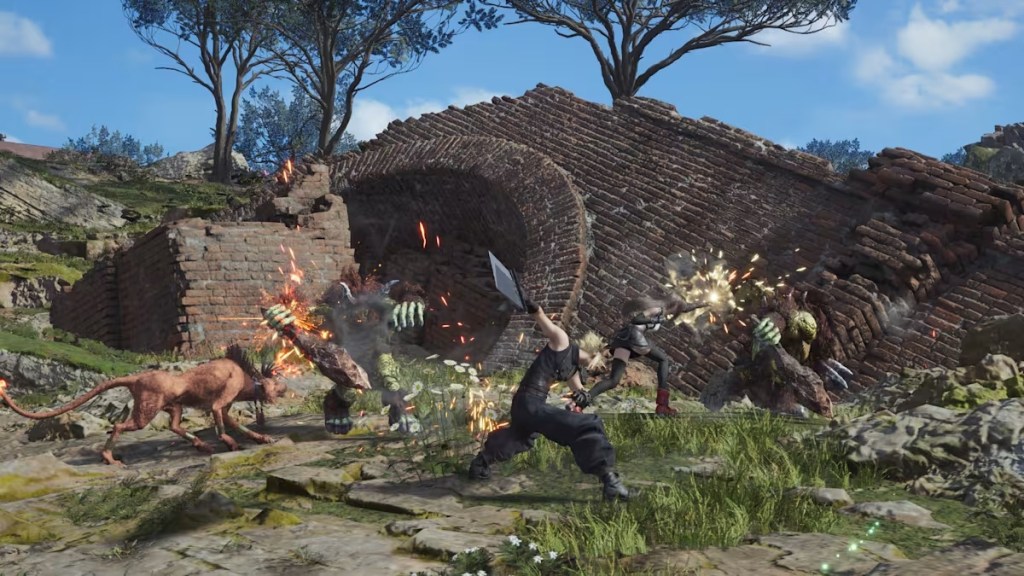
The other thing that carries over here from Final Fantasy VII Rebirth is of course the most instantly-notable change, the presentation, and once again what’s here is nothing short of stunning. Massive, incredibly detailed environments and characters, amazing lighting, gorgeous visual effects… as with the prior game, Final Fantasy VII Rebirth is a true showpiece on Nintendo Switch 2. That said, there are clear cutbacks made here compared to the versions on other modern platforms – framerates have been cut to a stable 30FPS, the resolution is lower than you’ll find on more-powerful platforms, and there’s less foliage density and more pop-in in the game’s lush outdoor environments. That said, the game still looks absolutely magnificent, and these cutbacks are shrewd compromises that don’t do much to mar what is still a visual feast of a game – we are well beyond the days of “Switch version” necessarily meaning a significantly uglier, less-playable version of the game.
And as with the visuals, the sound here is also impeccable, with truly excellent voice-acting all-around, and a wonderful orchestral remake of the original game’s soundtrack that truly adds to the cinematic presentation of this game. Every character in this game is voiced and voiced well, and every moment as you’re walking around, fighting enemies, or watching a cutscene, it will be set to music that perfectly fits the tone and setting. No complaints here.
In fact, apart from my personal qualms with the combat, and mild disappointment at some of the minor visual compromises made to get the game working on Nintendo Switch 2, I have hardly any complaints about Final Fantasy VII Rebirth at all. This is an absolutely stunning game that not only continues what Final Fantasy VII Remake started, but actually improves on it in multiple ways, taking what was already one of the most impressive remakes in videogame history and somehow finding even more ways to improve upon the source material. Oh yeah, and it’s somehow selling for only $50, on par with other versions of the game.
Of course, being the second game in a story-focused trilogy means you will really want to have played through Final Fantasy VII Remake before starting this game, but you really should, because Final Fantasy VII Rebirth is a truly impressive feat and a magnificent RPG, one that every fan of RPGs should play, and one that is in fine form (even if slightly compromised) on Nintendo Switch 2.
tl;dr – Final Fantasy VII Rebirth is the second game in the Final Fantasy VII Remake trilogy, and this game builds on its predecessor, expanding on the foundation that game laid in multiple ways, with an expanded world with more exploration, plenty of things to do, and new game mechanics, all while still keeping the ambitious reimagining of the original Final Fantasy VII’s story and what it even means to be a “remake”, with jaw-droppingly gorgeous graphics (even if some shrewd compromises had to be made to get the game working on Nintendo Switch 2). I’m still not the biggest fan of this game’s real-time action-based combat system, but beyond personal preferences and minor quibbles it’s hard to find much to complain about here – Final Fantasy VII Rebirth is an absolute must-play RPG, and a triumph that manages to rise above even the trilogy’s much-lauded first chapter. Do not miss this.
Grade: A+
You can support eShopperReviews on Patreon! Please click HERE to become a Sponsor!
This month’s sponsors are Jamie and His Cats, Ben, Ilya Zverev, Andy Miller, Johannes, Jaka, Jared Wark, Gabriel Coronad-Medina, Francis Obst, Kristoffer Wulff, Seth Christenfeld, and Vince Verrinoldi. Thank you for helping to keep the reviews coming!


Leave a comment