
Disgaea Mayhem
Genre: Action Brawler / Action-RPG
Players: 1
The Nintendo Switch 2 Difference
.
Review:
Disgaea Mayhem is a “Musou”-style Action Brawler with Action-RPG elements set in the same multiverse as the Disgaea series of Strategy-RPG games, where players take the role of N.A., a mercenary hired to assist the heir to a demon overlord’s throne who’s having trouble getting her dad’s underlings in line, but what she’s really upset about is her missing flan. Yes, the dessert.
It turns out, dear old daddy’s entire empire was built on the peace forged by bringing monsters together over a tasty plate of flan, and now all of his old lieutenants have rebelled against the princess for different flan-related reasons. Look, if you’ve played the Disgaea games, you’ll know that this is pretty on-brand for Disgaea. Not specifically flan per se, but just some kooky character motivation or another.
If you’re down for Disgaea’s silly brand of humor, it’s a delight, if a bit more single-minded than usual this time. I was tickled by the true reason for the defection of the first major lieutenant you tackle, John-Zuck, a giant who abandoned the overlord’s retinue because his doctor said he needed to cut down on sweets for the sake of his health, and the overlord’s flan was just too tempting. The princess’s solution? Whip up a flan with a big hole through the middle of it and call it a zero-carb flan.
Disgaea Mayhem’s static cutscenes are delivered with voiced dialogue that’s pretty good by the series’ cartoony standards, though also as per usual for Disgaea, less-noteworthy conversations are text-only. Even worse, you’ll quickly get exhausted and annoyed by every character’s one or two things they say during combat, which you’ll hear repeated ad nauseum.
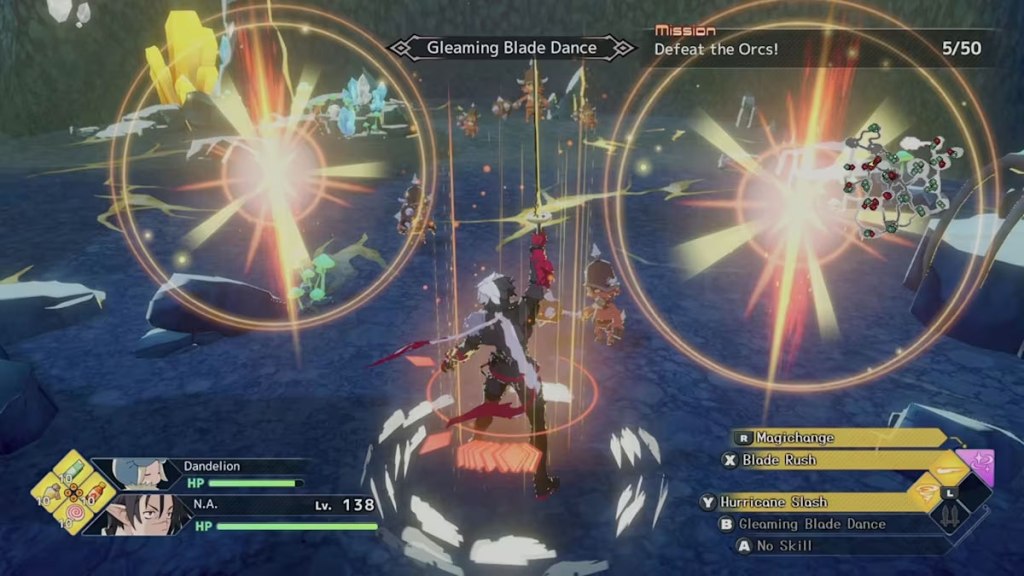
Graphically, Disgaea Mayhem has some issues. The game uses cel-shaded 3D visuals with anime-style characters and a decent number of enemies on-screen at any given time, and while the environments don’t have a ton of detail, there’s a lot of aliasing here, as well as some glitchy, flickering environments at times. This game wavers between looking passable and just outright ugly. What’s more, there can be some slowdown on Nintendo Switch when the action gets particularly busy. In short, while I wouldn’t say Disgaea Mayhem is outright unplayable on Nintendo Switch, it’s far from ideal.
When it comes to the gameplay, you can definitely see some effort was made here to transition elements of the Disgaea Strategy-RPG games into the more repetitive action-focused gameplay of a Musou game. Players can equip the same sorts of weapons and equipment those games have, and the Item World, Dark Assembly, and other elements of the series show up here and serve much the same function. And most importantly, when Disgaea Mayhem is at its best, it really captures the good sort of “number go up” grinding that the series specializes in, giving you the opportunity to improve every facet of your character’s stats as well as the equipment he’s using.
Unfortunately, Disgaea Mayhem has a few issues, both as a Musou and as an adaptation of the Disgaea games. First, even for a Musour game, this is extremely repetitive. There’s little variation in what you’re doing moment-to-moment – it’s just kill a bunch of enemies, move on, kill a bunch of enemies, move on, and eventually kill a boss character. Disgaea Mayhem doesn’t have you using your individual fighting to defend key points on the battlefield, protect a point of vulnerability, or break through enemy defenses so your forces can get through. In fact, you have no forces. It’s always just you, plus at most one helper monster character who tags along as you battle.
On this point, Disgaea Mayhem really misses out on one of the key elements of the mainline games, raising up a variety of units with different specialties. In the mainline series, you can have units that specialize in thievery and tossing other units to get to specific points on the battlefield, or units with area-of-affect abilities, or units with more focused high-damage attacks. Here, everything boils down to your weapon choice and your helper character – pick a melee weapon, or a ranged weapon, and you’ll have a few basic attacks, a few special attacks on cooldown, and an ability to let your monster pal morph into a supercharged weapon for you temporarily until you detonate it in an area-of-effect blast.
Or… just use a magic rod for gameplay that can be a bit slower, but results in what is essentially playing the game on easy mode as you run around to avoid enemy attacks while the magic charges up, and then stop long enough to release the stored magic as a barrage that auto-targets enemies, before going back to running around again.
The auto-targeting part of the magic rod is even more enticing since the camera in Disgaea Mayhem is terrible, sticking far too close to your character and leaving you open to attacks from behind. You can’t even fast-turnaround either as far as I can tell, and can only lock on to bosses, not individual enemies (even especially large ones). And good luck aiming most ranged attacks quickly.
Also, while I did say that this game includes the Item World from the mainline games, that’s a bit misleading, because all you’re doing here is just fighting wave after wave of spawning enemies within an enclosed arena – this has none of the strategy of the mainline games, no sneaking to the exit, no stealing good gear from enemies, no geo panels, none of that.
The result of all of this is a game that can still be fun, and it can still be fun with that “number go up” grinding… but if that’s what you’re looking for, the mainline Disgaea games do it far better with much more variety and creative gameplay. And if you’re looking for enjoyable action, you’re better off with one of the Dynasty Warriors, Hyrule Warriors, or Fire Emblem Warriors games – even though those games are also repetitive, they’re not nearly as shallow as the action in Disgaea Mayhem.
tl;dr – Disgaea Mayhem is a “Musou”-style Action Brawler with Action-RPG elements that takes the setting, tone, and mechanics of the Disgaea series of Strategy-RPG games and reinterprets it as an action-focused game with tons of characters on-screen to fight. Unfortunately, this game is shallow and repetitive even for a musou game, and while it does try to bring in elements of the mainline Disgaea series, those elements are a pale shadow of what we get in those mainline games. While this game still delivers enjoyable grind-focused gameplay the series is known for, you’re better off just getting a mainline Disgaea game for that… or if you want a Musou game, get a Dynasty Warriors, Hyrule Warriors, or Fire Emblem Warriors game.
Grade: C
.
The Nintendo Switch 2 Difference
Disgaea Mayhem (Nintendo Switch 2)
Genre: Action Brawler / Action-RPG
Players: 1
.
Review:
Disgaea Mayhem is an unfortunate example of a game that was released on both Nintendo Switch and Nintendo Switch 2 with no upgrade path – you have to decide which version of the game to get. So, how do the two versions compare? Let’s take a look…
I had a lot to say about this game’s graphical flaws on Nintendo Switch, and the Nintendo Switch 2 version improves on things… but there are still issues. This release has quality and performance modes, and both are an improvement over the Nintendo Switch version, but leave a lot to be desired. Both modes improve the resolution and framerate, with the quality mode looking visually better and addressing those visual glitches I mentioned in the review of the Nintendo Switch version. However, it still has nasty aliasing. Meanwhile, the performance mode still has the visual glitches (and maybe it’s just me, but I think it may look even worse), and while it may deliver a marginal improvement to the framerates, I think the improved framerates in the performance mode are plenty, and the game looks like less of an eyesore in that mode. However, either way, this game still doesn’t look great.
There were also some visual effects added here, in both modes. Most notably, in the first area, you now have the shadows of clouds on the stage that weren’t present in the Nintendo Switch version. They’re ugly, blotchy shadows (uglier in performance mode), but it’s an improvement all the same.
Finally, there’s the loading times – on Nintendo Switch, it took me 29 seconds to get to the title screen, 9 seconds to load a save file, and 9 seconds to load into a level. On Nintendo Switch 2, those times are cut down to 11 seconds, 5 seconds, and 5 seconds. A marked improvement!
So, in the end, yes, the Nintendo Switch 2 version of Disgaea Mayhem is definitely an improvement over the Nintendo Switch version in visuals, performance, and loading times. That said, it still leaves a lot to be desired, and definitely doesn’t look up to the standards we’ve come to expect from the Nintendo Switch 2, much like the Nintendo Switch version doesn’t live up to the standards of that platform. If you’re going to get this game, the Nintendo Switch 2 version is definitely the better version of the game on Nintendo platforms, but even having said that, it still looks pretty ugly.
tl;dr – Disgaea Mayhem is a “Musou”-style Action Brawler with Action-RPG elements that takes the setting, tone, and mechanics of the Disgaea series of Strategy-RPG games and reinterprets it as an action-focused game with tons of characters on-screen to fight. Unfortunately, this game is shallow and repetitive even for a musou game, and while it does try to bring in elements of the mainline Disgaea series, those elements are a pale shadow of what we get in those mainline games. While this game still delivers enjoyable grind-focused gameplay the series is known for, you’re better off just getting a mainline Disgaea game for that… or if you want a Musou game, get a Dynasty Warriors, Hyrule Warriors, or Fire Emblem Warriors game.
Grade: C
.
You can support eShopperReviews on Patreon! Please click HERE to become a Sponsor!
This month’s sponsors are Jamie and His Cats, Ben, Ilya Zverev, Andy Miller, Johannes, Jaka, Jared Wark, Gabriel Coronad-Medina, Francis Obst, Kristoffer Wulff, Seth Christenfeld, and Vince Verrinoldi. Thank you for helping to keep the reviews coming!


Leave a comment