
Fire Emblem: Fortune’s Weave
Genre: Turn-Based Strategy-RPG / Turn-Based JRPG
Players: 1
.
Review:
When Fire Emblem: Three Houses was released on Nintendo Switch in 2019, many saw it as the pinnacle of the series, marrying the Fire Emblem franchise’s well-established Turn-Based JRPG gameplay with Persona-style calendar management elements, character development, and relationship-building, as well as giving players three different factions to join, ensuring that players looking for replay value had three separate stories to explore.
When we got the series’ next installment on Nintendo Switch in 2023, Fire Emblem Engage, many players found it to be a disappointing step backwards for the series, still offering engaging combat, but lacking all of the added elements that made Three Houses such a success. Now in 2026, fans of Three Houses have cause to celebrate, because Fire Emblem: Fortune’s Weave on Nintendo Switch 2 is not just a game that brings back the formula of Three Houses, but instead choose to build on that formula and take it in interesting new directions.
.
Weaving a Story
This game takes place in the same world as Fire Emblem: Three Houses, but takes place in a region to the South of that game’s Fodlan, a continent called The Dagdan Empire. Players interested to play Fire Emblem: Fortune’s Weave need not have any prior familiarity with Three Houses, or any Fire Emblem game for that matter – apart from one supporting character in the form of the goddess Sothis, along with occasional mentions of the Fodlan continent, the two games don’t share any story, and Fortune’s Weave takes its time to acquaint you with its world, characters, and gameplay. In fact, it may go a bit overboard in that regard, but more on this farther down.
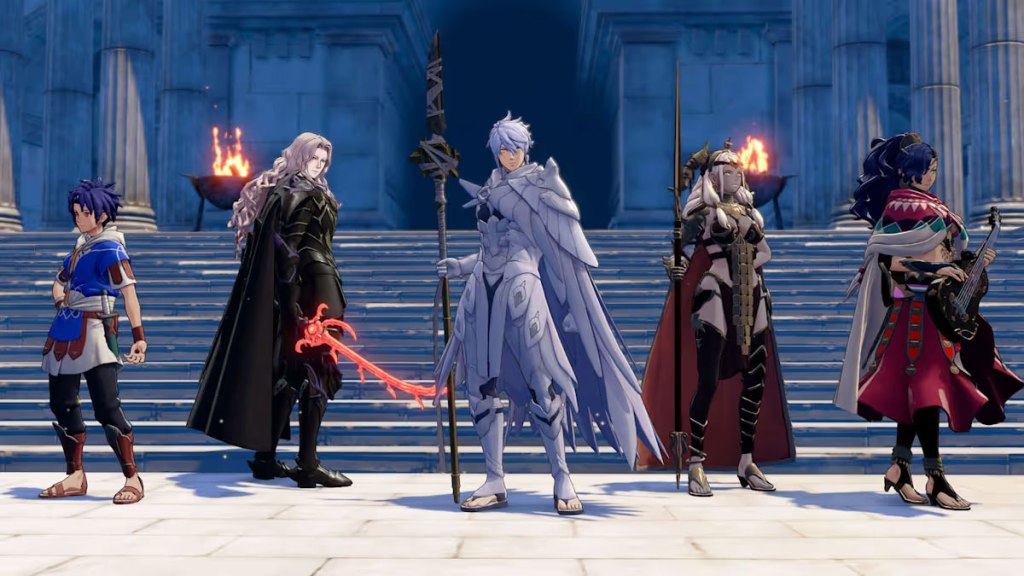
The story of this game starts five years after the time the majority of the game takes place, with The Dagdan Empire on the brink of being completely overrun by an army of risen dead led by the demon god Balor. A few remaining warriors make a desperate last attempt to avert catastrophe – through the help of the friendly goddess of fate, your character is permitted to remotely influence events of the past, with the goal of ensuring that a group of now-deceased legendary warriors survives to assist in the fight against the undead forces. To this end, players can choose to play through the stories of four characters deemed to be pivotal to the success of preventing the undead apocalypse.
Each of these four characters’ stories is distinct, with their own group of supporting characters, their own cutscenes, and their own story arc. However, the stories all crisscross into each other, feature repeat appearances in some capacity or other of a cast of dozens of supporting characters, and all focus on one central location that the characters pin their hopes on: the colosseum in the Dagdan capital, where a competition called the Heroic Games has been declared, with the winner promised the granting of a wish by the nation’s deific divine sovereign.
Of the four characters, I think three of them are excellent.
Cai is a scrappy youth trained with incredible fighting skills by his father, himself a highly-skilled warrior. However, Cai’s father has a past that’s catching up with him, tied to a crime he committed involving Cai’s mother. With Cai’s father being imprisoned with a death sentence hanging over his head, Cai joins the competition seeking to use his wish to free his father. Overall, Cai’s story has great overtones of youthful adventure and coming-of-age, and while Cai and his companions seem rather young to be playing at war games, both he and the other characters are well aware of this, forcing Cai to prove his abilities in ways the other characters don’t have to. In gameplay, Cai’s focus and specialty is growing crops, catching mounts, and using these skills to equip his army for mounted combat.
Leda is a skilled dancer whose jolly demeanor during performances hides a grim determination to seek out and murder the people responsible for the razing of her city and the slaughter of her father. She joins the competition while her group investigates the shady group behind the horrible act, and seeks to use her wish to fight and kill a renowned gladiator being held captive in the colosseum, the man who personally slew her father. Leda’s story is a revenge tale where her devotion to her deadly goal is weighed against the friendships she builds on the way to that goal. In gameplay, Leda can gain skills and influence by using her dancing skills to put on performances, and in battle she personally provides support boosts to teammates.
Theodora is the queen of the nation of Saramis that owes fealty to The Dagdan Empire but is mostly on good terms with this arrangement. The issue lies with the nation’s patron goddess of Yu Phas, which is seen as disgraced in The Dagdan Empire’s pantheon, with Theodora seeking to use her wish to restore this goddess to a place of honor and respect. However, as she fights to secure a bright future for her nation and their deity, she also fights an inner battle, as the magical arm she bears as a remnant of a struggle with her treacherous brother during her rise to the throne threatens to gradually chip away at her sanity, making her increasingly prone to moments of rage. This character’s story focuses on fulfilling the duties and responsibilities of a leader while losing one’s self to what is in effect a mental illness. In gameplay, Theodora is not only a powerhouse in her own right, but her skill as a leader gives her the ability to recruit and utilize battalions that act as area attacks that can be deployed only sparingly in battle but can have a huge effect.
Finally, there’s Dietrich, my least-favorite of the group. He seems set up to be the group’s “token evil teammate”, whose sole concern is fighting worthy opponents, and his wish entering the game is to get a really strong boat so he can get in a fight with the sea monster that shipwrecks him in the beginning of the game, seeing the creature as a worthy opponent. Yeah, I see this guy as one-dimensional, and not only that but his supporting cast is even worse, with the dark priest Fabio who “befriends” him so obviously evil and just overall a really slimy jerk, and you have to wonder why the adorably perky (bordering on irritating) Esmerelda feels compelled to stick with these creeps (yes, yes, “they saved my life”… but even so…). Er… anyway, Dietrich’s specialty in gameplay is being able to essentially summon combat opportunities into being, both for experience and renown. In combat, he’s a powerful attacker, with bonuses that push him into an aggressive play style.
What’s interesting is not only seeing these four stories play out, but how each of them interacts differently with the world around them. As previously mentioned, Cai’s young age forces him to constantly have to prove himself, but his personal connection to one of the deities ensures that he has access to her knowledge and insight on matters the others wouldn’t know about, and he also seeks out mentors, with one you eventually discover is the same man Leda seeks revenge on. Meanwhile, Cai and Theodora’s first encounter is when Cai unintentionally interrupts Theodora’s parade reception in the street, but the encounter can look different depending on which character’s campaign you’re playing given the added context each campaign offers.
Another interesting thing about this game comes with the added knowledge that the original intent was to have eight playable protagonists rather than four, and even though this scope was cut in half to be more reasonable (still expanding from Three Houses’ three factions), you can probably guess which characters were to be central to the cut campaigns, like the cat-masked Orchel and the laid-back merchant Talimun, as these characters seem to have a lot more going on than other recruitable characters.
I should also note that one wise change that was made from Three Houses is that this game’s different character-focused campaigns are no longer wholly-separate and do not require additional play-throughs from the beginning – after each character’s introductory chapters, once they’ve settled in the Dagsion capital and are ready to participate in the games, you’re given the opportunity to swap between them at any time you want, with all four campaigns eventually joining together late in the game’s story, with no need to start over from the beginning if you want to try out a different campaign, though players are encouraged to complete the first “Part” of each campaign before changing over to the next.
If you’re the sort of player who relishes in a long story campaign, buckle up, because a single play-through of just one character’s campaign lasts an estimated 50-60 hours, with a full completionist run of all four campaigns taking anywhere from 120 hours to over 160 hours. Fire Emblem: Fortune’s Weave may be one of only two Nintendo Switch 2-exclusive games to be priced at $80, but unlike Mario Kart World, Fortune’s Weave actually makes an effort to earn that by providing players with an extremely meaty campaign, and with each campaign having enough differences in story, tone, and gameplay elements that one could argue this is kinda’ like getting four games in one. Four games with reused content, but still.
.
Welcome to the Heroic Games
As I indicated earlier, Fortune’s Weave builds on the gameplay of Three Houses, but takes it in a different direction. In Three Houses, for much of the game players built relationships and trained units at the Hogwarts-esque Garreg Mach Monastery using a limited amount of in-game time, interspersed with Strategy-RPG battles. In Fortune’s Weave, you similarly have the big showdowns in the Heroic Games presenting players with a deadline forcing them to manage the use of their in-game time for what the player deems to be most effective at building up units’ experience, training skills, recruiting allies, and gathering resources. However, you’re no longer doing this within the confines of a school, instead you have a large city full of opportunities to build your character.
Oh, that’s not enough? Okay, then – you can exit the city, where you’re brought to a world map where you can travel to other locations on the continent, which present you with opportunities for battle and experience gain, trade, gathering resources, or completing side-quests for rewards and renown. This presents players with some clever choices – there are some things that can only be done in the capitol, and traveling takes precious time to do, but there are some rewards you can only gain access to by exploring the map and finding opportunities not present near the capitol. And thankfully when the deadline arrives, you’re automatically whisked away to the capitol for the competition and fully-healed, so no need to worry about being caught unprepared when the time comes.
I’ve mentioned renown a few times in this review, and that’s an important stat in Fire Emblem: Fortune’s Weave much like experience or money, because what you can do is gated off by your level of renown – the higher you get it, the more fighters will be willing to agree to join your group and the more access you have to training and other opportunities for advancement in the capitol.
When it comes to combat, the primary form of combat you have in Fortune’s Weave should look familiar to Fire Emblem fans, with the typical Strategy-RPG gameplay. Players can opt to play with old-school “permadeath” on or off, but even if you have it enabled, you’re still granted the ability in battle to use your patron goddess’s time-rewinding sand to turn back the clock and undo a particularly disastrous move that got a valued teammate killed.
I should note that this is one of the games that does without the paper-rock-scissors “weapon triangle”, but instead gives each weapon type its own advantages – swords have stronger added follow-up attacks, spears are more effective against cavalry, axes have a higher damage floor regardless of enemy armor (but lower chance to hit), hand weapons like gauntlets and handguns (yeah, this game has some sci-fi elements) give their user a higher rate of avoiding enemy attacks, and the bow and arrow is strong against flying units.
In addition, this game introduces “blaze art”, moves that some pivotal characters like the four leads can use, where they can sacrifice some of their health to perform a devastating attack, move farther on the battlefield, or do other special abilities. There are also cursed weapons that build up your power when used, but using them too much can cut a unit’s maximum HP in half for the remainder of the current battle.
There is one other major element I should mention here, and that is the return of dungeons, previously seen in Fire Emblem Echoes: Shadows of Valentia. However, these work a bit differently. Battles in dungeons only occur when you run into enemies, and unlike the majority of the game are not Strategy-RPG battles but a sort of Turn-Based JRPG battle, where each turn players must choose one unit to attack and receive the enemy’s attack, with the option to have a pair of units tag-team until you’ve expended this ability. I’ve gotta’ say, even though I wouldn’t necessarily be opposed to standard JRPG battles in this style of Strategy-RPG, the way Fortune’s Weave does them is odd in a way that I don’t care for, and I actually think this is one of the game’s weak spots.
.
The Sights and Sounds of Dagdan
When it comes to presentation, Fire Emblem: Fortune’s Weave is good… but not in a way that this game clearly needed the Nintendo Switch 2 to run. The game’s environments are sometimes large but never massive, the anime-style cel-shaded 3D characters look great and animate well but aren’t anything truly jaw-dropping. Everything looks fine, but I see no reason this game couldn’t have been released on Nintendo Switch, perhaps with lower resolution and framerates.
However, having said that, the voice acting in this game is magnificent. While a few characters I’m not terribly thrilled with (yeah, looking at you, Fabio and Esmerelda), the rest of the voice cast delivers an impeccable performance, with Cai’s voice actor doing a great job treading the line underlining his youth without making him intolerable, Leda’s voice actress really selling her passionate burning anger, and Theodora’s voice actress doing an excellent job selling her struggle (and at times failure) to contain her rage. The smaller roles here are great too, with some of the recruitable characters who have been given less of a focus given added depth through great writing and voice acting.
Meanwhile, this game’s instrumental, orchestral, and choiral soundtrack is excellent, though I don’t think there’s any theme that grabs me quite as much as much as I liked Three Houses’ Fodland Winds. Still, you have some excellent music here, with examples including True to His Colors, The Blaze – Cycle of the Sun, Hope Endures, Pale Raven’s Landing (and its Combat Version), and I particularly enjoyed the stirring theme A Life of Glory (and its Combat Version) which includes bits of the classic Together, We Ride theme. Overall, it’s a really solid soundtrack that does a great job getting you invested in the characters’ stories and then amped up for the battles.
Before concluding, I should note that this game does make use of Mouse Mode, which is nice, but I personally preferred traditional gamepad controls. Odd, since I thought the addition of touchscreen controls was one of the best updates to the series control back during the Nintendo DS and Nintendo 3DS era. Still, for those who want it, it’s here.
.
Does This Game Weave a Worthwhile Tale, or is its Fortune Fickle?
Overall, I think Fire Emblem: Fortune’s Weave has a few rough edges, like the standard JRPG Turn-Based combat and a presentation that feels like it could stand to be more grandiose to match the scale of the story being told (not to mention the price tag). However, I think that perhaps some rough edges are to be expected when this game just has so many edges – its scope is the most ambitious this series has ever seen, and most of the things it does, it does extraordinarily well.
With three excellent stories (and one “meh” story) combining into one, a massive cast of lovable characters (even if a few are duds), a great soundtrack, excellent voice acting, solid Strategy-RPG combat, a wealth of options to explore building up and customizing your parties, and a game that is not only massive, but that justifies its massive size by constantly introducing new gameplay and story elements, even with its flaws I still feel like Fire Emblem: Fortune’s Weave is an incredible feat, an absolute must-have for Strategy-RPG players, and probably a game fans of traditional RPGs should consider too.
tl;dr – Fire Emblem: Fortune’s Weave expands on the Strategy-RPG gameplay and calenday-mindful relationship-building and party-training mechanics previously seen in Fire Emblem: Three Houses, taking the ideas of that game and building on them and expanding on them in new exciting ways with four intertwined stories that are each the length of a full game in their own right… and three of those stories are great! Okay, not everything this game tries succeeds, with the new traditional RPG sections being pretty lacking and the graphics not living up to what we expect from a Nintendo Switch 2 game. However, this is such a massive game that tries so many interesting things, with many of those things succeeding, that every Strategy-RPG player should consider this a must-play, and even fans of more traditional RPGs need to take notice. And while the price is steep, the massive amount of gameplay on offer here makes that price worthwhile. A truly magnificent accomplishment, do not miss it!
Grade: A+
You can support eShopperReviews on Patreon! Please click HERE to become a Sponsor!
This month’s sponsors are Jamie and His Cats, Ben, Ilya Zverev, Andy Miller, Johannes, Jaka, Jared Wark, Gabriel Coronad-Medina, Francis Obst, Kristoffer Wulff, Seth Christenfeld, and Vince Verrinoldi. Thank you for helping to keep the reviews coming!


Leave a comment