
Rogolf
Genre: Sports (Mini-Golf) / Rogulike
Players: 1-4 Competitive (Local)
.
Review:
Rogolf, released in 2026 on PC and Nintendo Switch, is a game that combines Mini-Golf gameplay with Roguelike structure, with players tackling holes with an attempt to reach score totals, while also gaining upgrades between rounds to help them reach those goals, with everything wrapped in a framing device of players taking the role of a new employee at some sort of golf-testing company staffed by robots.
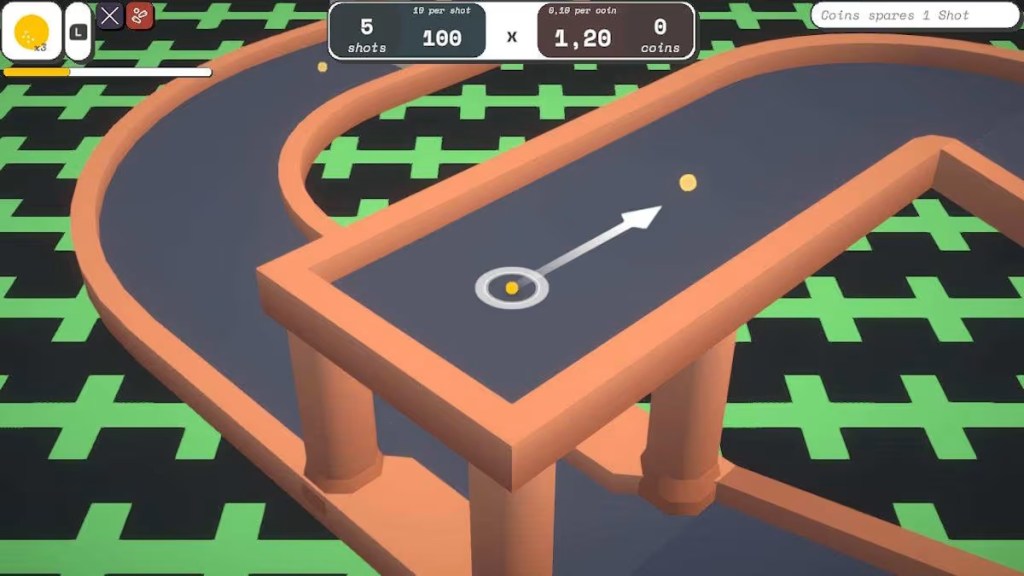
The presentation here is far from impressive, using simple 3D visuals that get the job done, but don’t impress in any way and don’t have much in the way of personality apart from the robots you interact with between rounds. This is backed by a subdued synthesized soundtrack that similarly fails to leave much of an impression.
When it comes to the gameplay, it’s hard to play this game without being reminded of Balatro, and it would not surprise me at all if the creators of Rogolf saw that game and asked themselves “what if we did that, but replaced Poker with Mini-Golf?”. On the surface, that sounds to me like a winning formula, but a winning formula still needs good execution.
The basic Balatro structure is here – players play through three mini-golf courses each round, with their performance in those rounds converted into scores. There’s no boss or enemy to fight here, just a score threshold, and in this case a limited number of attempts to get under par in each hole. Run out of attempts, or fail to meet the score threshold, and your run ends. At the end of each round, you get the opportunity to spend coins you’ve collected on the courses to purchase upgrades to improve your scoring potential and add other abilities to help you complete your goals. And with that, you’re trying to continue as long as possible.
Since I started with the Roguelike structure, I suppose let’s talk about how that fails to reach the same heights as Balatro. In short, you’re given fewer opportunities to upgrade, those upgrades are far less interesting and varied, and there’s little in the way of clever synergies to find in those upgrades. Never while playing this game did I find myself thrilled with a new upgrade – at best I was just hopeful that it would improve things for me.
Ah, that’s another thing, hopeful – the correlation between performance and score is decoupled here in a way that makes it difficult to gauge how well you’re actually doing outside of the results screen. And while some upgrades add points and multipliers based on specific behavior like hitting walls or air time, it never feels like any of this truly adds up in a way that supercharges your performance like you tend to look for in a really good Roguelike run.
However, the real problem here is the basic Golf gameplay. Players are forced to play from a fixed isometric perspective that can often make it difficult to tell if you’re aiming the way you want, and this problem is compounded by a shot power mechanic that makes it difficult to tell how strong your shot will actually be once you let it loose. As a result, aiming in Rogolf often ends up being wildly different than how you intend it, making for frustrating gameplay that often leads to the player feeling their losses are unearned.
Balatro succeeded because the core gameplay of Poker works well, and the added Roguelike elements were strong and skillfully applied. The same could have been true for a Mini-Golf/Roguelike mash-up too, but that doesn’t end up being the case in Rogolf, with frustrating and unpredictable Mini-Golf gameplay and boring, unsatisfying Roguelike elements. The result is a game that I can’t recommend to Mini-Golf fans or Roguelike fans.
tl;dr – Rogolf is a game that combines Mini-Golf gameplay with Roguelike structure and mechanics, in a way that seems to try to copy the success of Balatro’s Poker and Roguelike combo. Unfortunately, it doesn’t work here, because each of the individual components is done poorly, with frustrating unpredictable Mini-Golf gameplay and lackluster Roguelike elements, adding up to a disappointing failure to meet the potential this game could have had.
Grade: C-
You can support eShopperReviews on Patreon! Please click HERE to become a Sponsor!
This month’s sponsors are Jamie and His Cats, Ben, Ilya Zverev, Andy Miller, Johannes, Jaka, Jared Wark, Gabriel Coronad-Medina, Francis Obst, Kristoffer Wulff, Seth Christenfeld, and Vince Verrinoldi. Thank you for helping to keep the reviews coming!


Leave a Reply