
The Legend of Zelda: Ocarina of Time
Genre: Action-RPG
Players: 1
.
Review:
What can even be said about The Legend of Zelda: Ocarina of Time that hasn’t already been said countless times in a multitude of reviews, video essays, podcasts, and other media? First released in 1998 on Nintendo 64, this game is still to this day touted by many as the greatest game ever made, even 28 years later. It remains the highest-rated game of all-time on Metacritic, a full point above the next game in that list.
It was massively influential, creating game mechanics and other innovations that are still used to this day across videogames, even in games that play nothing like Ocarina of Time. It remains a master class in level design, puzzle design, world design, game progression, and numerous other areas, and still surpasses many modern games in these areas. And it created the framework that every Zelda game in the series would follow for the next few decades, until The Legend of Zelda: Breath of the Wild deliberately broke the mold to give series fans something different and new, with people divided on whether or not this was a good thing. Brilliant. Earth-shattering. Game-changing. Timeless.
It was ported to every subsequent Nintendo console, twice on GameCube as a part of two different Compilation discs, and then on Wii and Wii U via Virtual Console, and Nintendo Switch and Nintendo Switch 2 via the Nintendo Switch Online Expansion Pack – Nintendo 64 – Nintendo Classics App. It even received a full remake on Nintendo 3DS in 2011. When it comes to the list of classic Nintendo games that “need” a modern-day remake, I would argue that Ocarina of Time is low on that list. If you own either Nintendo Switch platform and subscribe to the Nintendo Switch Online Expansion Pack, you can already play the game, and it still plays remarkably well to this day, no need for a new release.
Well, Nintendo did it anyway. Following in the footsteps of the Nintendo Switch 2 Remake of Star Fox 64 earlier the same year, Nintendo has brought us a complete ground-up remake of Ocarina of Time on Nintendo Switch 2 in 2026. The challenge this time was a bit different. With Star Fox 64, it was building a new foundation for a franchise that had been listless for some time, using the strongest material the series had ever produced. In the case of Ocarina of Time, the Zelda series is still going very strong, and so the question here became “how do you improve on a classic that many players will say is already just about perfect?”
As with Star Fox 64, the answer for The Legend of Zelda: Ocarina of Time seems to be “use the graphical prowess of current-generation hardware to make the game a visual tour-de-force, polish up what few rough edges there are, make the small improvements that don’t threaten to ruin what made the game great, and otherwise if it ain’t broke don’t fix it”.
The result is a faithful remake, but one that makes numerous subtle, savvy changes, along with the one very big change (the graphics) that helps to make this old experience feel brand new again. This is still very much the same game we got back in 1998, but polished and fine-tuned to such an extreme that it’s staggering.
.
“Look, Link! You’re big now!!! You’ve grown up!”
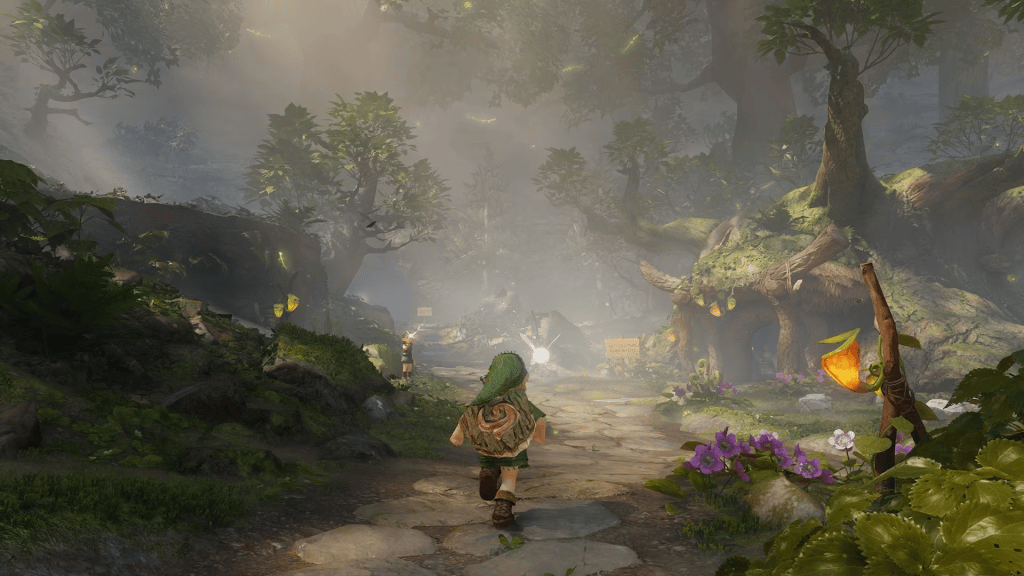
Let’s talk about what’s changed to start with here, and the obvious place to begin is the graphics. The Legend of Zelda: Ocarina of Time on Nintendo Switch 2 might just be the most graphically-impressive game I have ever played? To be fair, the game’s world and scope are relatively small compared to modern open-world games, even games in the Zelda series like Breath of the Wild and Tears of the Kingdom. Yet, while it’s smaller in scale, Ocarina of Time on Nintendo Switch 2 injects what’s here with painstaking detail, using imagination to gloriously fill in the gaps.
This game has the best-looking grass I’ve seen in a videogame, with multiple different kinds of grass all responding realistically to the trod of Link’s feet. This game has some of the best use of atmospheric fog I’ve seen in a videogame, with layers of the stuff flowing over creepy areas and subtly cut into as you pass through before filling back in realistically. This game is a contender for best-looking water in a videogame, with trickles leading to small streams leading to a roaring current or a clear lake, with light both reflecting and refracting beautifully. Walls that were bare in the original release now sometimes have decorations befitting the culture of the area. Light and shadow are gorgeous here, both setting the tone of scenes and even adding small touches like the way heart containers sparkle lights like a jewel hit by the light in a way that spreads into the immediate area around them like a disco ball.
All of this is at a silky-smooth framerate and a relatively clear resolution. I’ve seen some wishing the resolution was a little higher, but I have zero complaints in that regard. The only issue I think I can understand some people making is that the character designs, while just as intricately-designed and lovingly-detailed as the environments, seem a bit “off” in an uncanny valley sort of way. I think it’s the noses, which are often a bit too large, flat, and sharp… but that’s purely a subjective opinion, and even speaking as someone who doesn’t care for them, I got over that issue pretty quickly when the game is overall this jaw-droppingly stunning. Plus, while I may take issue with this element of the game’s style, other stylistic choices are brilliant, such as the way the Kokiri forest now really comes across like a place out of a fairy tale. Oh, but there is one graphical issue that’s less subjective – when speaking, characters’ mouths don’t match up with their words. Given the amount of detail elsewhere in the game, this is kinda’ distracting.
Before moving on, I should also note that while the original game had some places like Hyrule Castle Town and the inside of Link’s house as pre-rendered images that Link and other 3D characters walked in, here those places are fully-navigable 3D environments. What’s more, going into and out of houses is largely seamless, with the only scene transitions being tone-setting ones like entering/exiting Kokiri forest and Hyrule Castle Town.
.
“Just follow your ears and listen to the sounds coming from the forest! Hoot hoot!”
There’s also the music, which has all been lovingly recreated here in a way that fits the high-quality visuals. Here’s where I normally use a few examples, but honestly it’s the entire soundtrack, top to bottom, save for a few exceptions – surprisingly, I don’t like what they’ve done for some of the ocarina melodies like the Sun’s Song, where here they’ve switched up legato and staccato notes in a way that sounds wrong to me. Again, this may be personal preference, but I mention it all the same. Still, for the most part, if you’re wondering whether your favorite song in this legendary soundtrack was done justice, the answer is almost certainly “yes”.
The sound design here is impeccable, with the sound really low-key setting the tone of the environments you’re in whether it’s the raging waters leading to Zora’s Domain or the harsh winds of approach to Gerudo Desert, with your footfalls sounding different depending on what you’re treading on. Yet, this game wisely retains the iconic sounds from the original game when you use a sub-weapon or pick up a heart piece, or even when you pick up a cucco. The sound design here is a pitch-perfect modernization that doesn’t abandon what made the original iconic.
Finally, let’s talk about voice acting. What’s here is good, though the writing can be a bit off at times. I particularly like the voice work for Saria and Navi (who is not at all annoying in this game, believe it or not – she’s one of the best characters now, and I can’t recall her ever shouting “Hey!” or “Listen!”), and those who follow voice actors (or who watch Critical Role) will be delighted to discover that Matthew Mercer is reprising his role as Ganondorf after voicing the character in Tears of the Kingdom.
The problem is… all of that is in story cutscenes, and most of the dialogue in Ocarina of Time is still conveyed via text with single-word utterances or grunts to accompany what’s being said. Look, I understand that this style of storytelling is a bit nostalgic for some, but this is one relic I would have been happy to leave in the past – Nintendo, please start fully voicing your characters. If you want to keep Link as a silent protagonist that’s fine, but at this point the way you’re doing things is starting to be embarrassing.
.
“A thing that does not change with time is a memory of younger days.”
When it comes to changes to the actual gameplay, there are many, but most are subtle and easy to miss. Some minor changes to level design for improved signposting or to accommodate the new jump button (which doesn’t really add much to the game, to be honest), quality-of-life improvements like assigning boots, masks, Navi, and the Ocarina to different directions on the D-Pad so you can instantly swap them in when needed (yes, now the Water Temple is much less tedious), an ability to quick-swap sub-weapons using a fast menu similar to the one in Breath of the Wild, Tears of the Kingdom, and Echoes of Wisdom (and far less cumbersome than those due to a much more limited selection of equipment), reworked dialogue for better signposting, the ability to side-step while riding Epona, a quick-reference for the songs you’ve learned when you use the ocarina, the ability to hold down the A button to run a tad faster, updated maps indicating the locations of important items and points of interest… it’s a lot, and I think just about everything here is welcome and genuinely improves the game.
As far as entirely new changes, you have a new fifth bottle to collect, new bigger wallets (with some items increased in price in shops as a result), a new Business Scrub Seed item to summon a Deku Scrub shopkeeper wherever you are, a new echo gem item to alert you to nearby gold skulltulas, a new “Threads of Time” menu to help you keep track of quests, a new unlockable Hall of Fallen Foes where you can look at character models or partake in boss rush challenges, new “fairy thoughts” instances where you can use hints to find treasures or other curiosities… none of these drastically affects the overall gameplay, but these are significant additions all the same.
There are also new additions that make use of the unique hardware of the Nintendo Switch 2. Sub-weapons like the slingshot, bow and arrow, and hookshot can now be controlled with optional gyroscopic aiming. The game lets players who wish to use the Nintendo Switch 2 microphone to hum or sing ocarina themes rather than playing the instrument using buttons (a gimmicky option I think most will skip). There’s Amiibo support (most Zelda series Amiibo figurines give you some extra consumable items, while new Ocarina of Time Amiibo figurines unlock retro-style Zelda and Link masks), and connectivity with the Zelda Notes smartphone app that tracks your activity, provides and interactive map, and a touchscreen ocarina. The game itself doesn’t support touchscreen on Nintendo Switch 2, nor Mouse Mode, but otherwise it’s a decent set of updates to make use of the new hardware.
Of course, this is all skipping over the biggest gameplay update, the change so obvious that many won’t even realize it wasn’t in the original game: you can now independently control the camera. Yeah, as crazy as that sounds, every prior release of Ocarina of Time was designed for a game platform that only had one analog input. But like most modern games, including Breath of the Wild and Tears of the Kingdom, you use the left analog stick to move, and the right stick to move the camera. And this feels completely natural. Well, save for one issue – if you’re holding down the A button to run, it’s awkward to try to control the camera at the same time.
Okay, so going through all of that… wow, that’s a huge list of changes, right? But in the end, none of these fundamentally changes the core game, which still plays much like the original. And for the most part, all of these changes just provide a smoother, more enjoyable way to access that classic gameplay, with fewer annoyances and hassles.
So let’s talk about that classic gameplay, then…
.
“And I’m just 380 years old!”
Okay, so let’s get down to it. This game is 28 years old, and while there are lots of small changes to add polish and smooth the rough edges, this is still a largely faithful remake. Just how well does The Legend of Zelda: Ocarina of Time play in the modern day?
Simply put: This was arguably the greatest game ever made when it released 28 years ago, and it is still arguably the greatest game ever made still to this day. The exquisite pacing, the genius level design, the brilliant puzzle design, the iconic bosses, the solid combat, the world filled with wonderful secrets to discover, a delightfully diverse array of items and equipment to use… none of this stuff feels like it has aged a day, and it’s still the pinnacle of the Action-RPG genre even to this day.
Now, that’s not to say that there’s nothing here that’s aged poorly. The controls for Epona seem frustratingly stiff. The frequency of stuff you’ll want to buy makes it feel like you need to do a lot of grinding for rupees. The need to use the ocarina to fast-travel and only once you’ve learned the songs to do so can be tedious, especially if you need to go back and forth in time via the Temple of Time. Oh, and some of the things you find or items you collect are of questionable utility to you until later in the game.
But really, these are largely nitpicks. The Legend of Zelda: Ocarina of Time is often regarded as the best game ever made for good reason – because it really is that good, and for the most part this game has aged impeccably well.
.
“They say that you may find something new in dungeons that you have already finished.”
Earlier in this review, I said that when it comes to the list of classic Nintendo games that “need” a modern-day remake, Ocarina of Time is low on that list. And that’s true – it didn’t need this remake. But I’m glad it got this remake all the same. I’ve said it numerous times already, this is one of the greatest games ever made, and this release on Nintendo Switch 2 is the absolute best way to play the game, bar-none. It’s not the absolute definitive way to play – it lacks features that were in earlier releases like the Master Quest.
However, even with that omission it’s hard to deny that The Legend of Zelda: Ocarina of Time on Nintendo Switch 2 takes an absolute masterpiece of a game and gives it a remake treatment befitting a masterpiece, with a massive list of small improvements that largely leave the core gameplay intact while improving nearly everything that remained to be improved, as well as giving it one of the best graphical presentations of any game ever.
If you’re not a Zelda fan, or got your fill of Ocarina of Time and refuse to let new bells and whistles draw you back, I suppose there’s nothing here that’s going to change that.. but if you’re pretty much anyone else, I think you need to consider The Legend of Zelda: Ocarina of Time on Nintendo Switch 2 an absolute must-have game. Do not miss this.
tl;dr – The Legend of Zelda: Ocarina of Time on Nintendo Switch 2 takes a game widely-agreed to be one of the greatest games of all-time and gives it a largely faithful remake that improves it in countless small ways and a few very major ones, with one of the most impressive graphical presentations of any videogame ever and a huge array of quality-of-life improvements. The result is still at its heart the same legendary Action-RPG, yet so thoroughly-improved it feels brand new. Unless you absolutely refuse to revisit this medium-defining classic, you need to consider this remake an absolute must-play game.
Grade: A++
You can support eShopperReviews on Patreon! Please click HERE to become a Sponsor!
This month’s sponsors are Jamie and His Cats, Ben, Ilya Zverev, Andy Miller, Johannes, Jaka, Jared Wark, Gabriel Coronad-Medina, Francis Obst, Kristoffer Wulff, Seth Christenfeld, and Vince Verrinoldi. Thank you for helping to keep the reviews coming!


Leave a Reply